για Ελληνικά πατήστε εδώ
…and anticipation
Most recent events oblige us to confront multiple challenges that threaten our natural environment and wealth, like floods, fires etc.
So we have to face our part of responsibility too, which we all too easily choose to overlook.
Being at the apex of creation, created in God’s image, ours is the task of collaborating with God’s will so that we can say: “all is very good” (Gen.1, 31).
The story of Adam’s and Eve’s Fall at the Garden of Eden points out the tragic consequences our choices have upon our world and its future.
Human action takes on cosmic dimensions, for creation is inextricably interwoven with humanity’s destiny.
For that very reason Christ came into the world and became one of us (excepted sin) and opened to us the way to salvation, i.e. our liberation from the consequences of sin.
These consequences are not simply “material” and earthly, but they are primarily spiritual.
But, God, through His Son, gave us His Spirit! Saint Paul clearly states:
The creation waits in eager expectation for the sons of God to be revealed (…) in hope that it will be liberated from its bondage to decay …
Therefore, we anticipate the best for our future new world, beginning from ourselves and aligning ourselves to God’s grace and will.
“God “does not want that anyone should perish, but that all should come to repentance”.
(2 Pet. 3, 9).
The creation waits in eager expectation
The creation waits in eager expectation for the sons of God to be revealed.
For the creation was subjected to frustration, not by its own choice, but by the will of the one who subjected it, in hope that the creation itself will be liberated from its bondage to decay and brought into the glorious freedom of the children of God.
We know that the whole creation has been groaning as in the pains of childbirth right up to the present time. Not only so, but we ourselves, who have the first fruits of the Spirit, groan inwardly as we wait eagerly for our adoption as sons, the redemption of our bodies.
(Rom. 8, 19-23)
In between heaven and earth
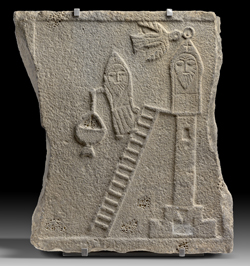
Only a few might know the odd story of Saint Symeon the Stylite, who spent the last 37 years of his life upon a pillar (STΎLOS in Greek) over twenty meters in height, in the desert of Northern Syria near Aleppo.
It is also not widely known that this very ascetic holy man played a most important role in the Christianisation of Lebanon.
It is said that he descended from his pillar only on two occasions, namely when a bishop had come to see him and when the Emperor of Byzantium Zeno visited him. (i.e. the Emperor of the Eastern Roman Empire).
From up there he preached the Gospel to the crowds that flooded the region to see him and obtain his teaching; he ate sparsely food hoisted in a basket to him once a week.
He was born in 388 and lived until 459, so he is contemporary to two Ecumenical Councils, those of Ephesus and Chalcedon, in 431 and 451 AD respectively.
After his death many were his imitators, and the Syrian Desert became populated with hundreds of stylites in many areas, from south of Damascus to Kobani in the North.
The last known stylite lived in the 20th century in Georgia
The White Martyrdom
 What has been the motivation of the stylites?
Where from were they drawing the force to lead such an ascetic life?
Saint Symeon himself provides the answer:
“As our Lord Jesus Christ spent three hours, for our sake, hanging on the cross, in between heaven and earth, so do I desire, also, to spend my life in between earth and heaven in imitation of His love for me and for the whole world”.
Once the persecutions ceased in 313 AD, under Constantine the Great by the Decree of Milan, many Christians could not easily get accustomed to the new conditions of freedom and tolerance.
There were many who considered that they were not offering enough to God, since the Red (i.e. bloody) martyrdom was not asked of them anymore, thus they chose to voluntarily lead a hard ascetic life; that manner of life became later known as the “White” martyrdom.
The ascetic movements multiplied, especially in the Orient, in Syria, Lebanon, Egypt and Cappadocia.
The ascetics, anchorites, hermits, monks etc. rivaled each other in continual prayer and in their hard practices for the love of Christ and the Church.
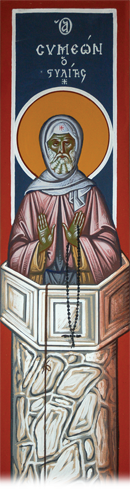
The αβοωε icon of Saint Symeon may be seen in the monastery of the Saints Cyprian and Justine in Fylé; Attica, Greece; made in 1972/ 73 by the iconographer Chris Stylianeas.
Did you know…
 The word Ocean has its origin in the Greek words aukύs /“okύs” (= acute, quick, fast-moving) + als (salt, sea).
Homer thought of the Ocean as a big river flowing round the land in a cyclical way, returning back to itself.
In Geography we name five oceans: the Pacific, the Atlantic, the Indian, the Arctic and the Antarctic.
The Ocean is a powerful symbol of strength, life and immensity.
It is also a symbol of the destiny of the individuals in their strife to be united to the Divine; it dynamically unites every individual drop of water into itself and they turn, then, into something well beyond themselves.
The expressions “a drop in the ocean” and “I float in oceans of happiness” etc. show how in everyday parlance the image of the water, in general, and of the sea and ocean, in particular, moves and inspires us and contributes to our thought formation.
Courage!

The photo on the right shows what remained from St. Symeon’ s pillar, 40 km from Aleppo, in Syria.
Four basilicas had been built around the pillar, which was covered by a wooden octagonal roof.
Earthquakes and war have contributed to their destruction.
Our present time is also a time of renewed persecution for the Christians in many parts of the world.
The Lord has warned us: “Remember the words, I spoke to you: No servant is greater than his master. If they persecuted me, they will persecute you also. If they obeyed my teaching, they will obey your also” (John, 15, 20).
This is Christian life: there always is tension between heaven and earth, our desire for God and our attachment to the earth, our zeal to spread the Gospel and the enmity of the world, our strength based on the Spirit’s power and our weakness and inefficacy when we limit ourselves to our own resources.
We have courage, however, for He who has “overcome the world” (John 16, 33) is on our side.
The Ocean’s Song
We walked amongst the ruins famed in story
Of Rozel-Tower,
And saw the boundless waters stretch in glory
And heave in power.
O Ocean vast! We heard thy song with wonder,
Whilst waves marked time.
“Appear, O Truth!” thou sang’st with tone of thunder,
“And shine sublime!
“The world’s enslaved and hunted down by beagles,
To despots sold.
Souls of deep thinkers, soar like mighty eagles!
The Right uphold.
“Be born! arise! o’er the earth and wild waves bounding,
Peoples and suns!
Let darkness vanish; tocsins be resounding,
And flash, ye guns!
“And you who love no pomps of fog or glamour,
Who fear no shocks,
Brave foam and lightning, hurricane and clamour,–
Exiles: the rocks!”
(Victor Hugo, 1802-1885
The Exaltation of the Cross

Emperor Heraclius, in the 7th century in Jerusalem, took back form the Persians the Holy Cross, which had fallen into their hands.
Saint Helena, the mother of the Emperor Constantine the Great, had discovered the Holy cross three centuries earlier.
Heraclius, in a moving ceremony, lifted triumphantly the Cross high up, in the Holy City for all to see.
The calendar showed 14 September 629 AD and the day is commemorated as “the Exaltation of the Cross”.
The cross has a central place in Christian spirituality. The Lord Himself tells us to carry our cross and follow Him.
It has now become the symbol of God’s immeasurable love for mankind and His creation.
There is no reason to shun the cross; the secret of the saints is that they willingly embrace it; then they become strong with Christs strength!
click here for Greek
 Open Reflections
One thought on “Expectation…”