
…will flow
…from within him who believes in me, as the Scripture has said (John, 7, 38).
This is the assurance our Lord gives us, meaning the gift of the Holy Spirit that is diffused to all faithful.
Its purpose is two-fold: our personal sanctification, as well as our orientation toward our fellow men and women, so they– in their turn– may taste the grace and wisdom of God.
Sunken inside the dark waters of a world in need of salvation, when we get with Christ into the holy waters of Baptism we emerge as “a new creation”, “clothed Christ” (Gal. 3,27), children of the Light, free and heirs of His kingdom.
The grace and joy of Christ fill our minds and hearts and, because of their nature, they cannot be constraint or kept inert, but they overflow finding outward expression too.
Like the river that rushes into the sea, carrying so many things in his waters and vivifying the earth at its passage, so is he who is moved by the Spirit: he encourages life wherever he goes and opens up the path to those who seek God.
We are not only children of God by grace, but His collaborators as well.
Already, at the times of Genesis, “God put man” created in His image “in the garden of Eden to work it and take care of it” (Gen. 2, 15).
And now, at the “last times”, Jesus tells us: “As the Father has sent me, I am sending you” (John, 20, 21). “Go, therefore, and make disciples of all nations, baptising them in the name of the father and of the Son and of the Holy Spirit, and teaching them to obey everything I have commanded you. And surely I am with you always, to the very end of the age” (Mt. 28, 18-20).
Rooted in the People of God
There are two memories that should be asked to be safeguarded in our people. The memory of Jesus Christ and the memory of our forebears.
The faith we have received was a gift that came to us in many cases from the hands of our mothers, from our grandmothers. They were the living memory of Jesus Christ within our homes. It was in the silence of family life that most of us learned to pray, to love, to live the faith. It was within family life, which then took on the shape of parish, school, and community that the faith came into our life and became flesh. It was this simple faith that accompanied us often in the many vicissitudes of the journey.
To lose our memory is to uproot ourselves from where we came and therefore is also not even knowing where we are going. This is fundamental, when we uproot a lay person from his faith, from that of his origins; when we uproot him from the faithful Holy People of God, we uproot him from his baptismal identity and thus we deprive him of the grace of the Holy Spirit. Pope Francis, 19/3/2016


The joyful message of faith
From the beginning the Christians felt the need to decorate their churches with icons from the life of the Incarnate God and, in this way, to demonstrate, with the help of the fine arts, the joyful message of their faith.
Excavations that took place between the years 1892-1932, north-west of the lake of Tiberias in Galilee, uncovered mosaics on the floor of the church of the Multiplication of Bread and Fish.
An ancient church (5th c.) had been built on the presumed site where Jesus performed the afore-mentioned miracle (John, 6, 1-15).
This mosaic is found in front of the altar where the Eucharist is celebrated. (See photos on the right). It depicts two fish on either side of a basket full with loaves of bread. The bread has on it the sign of the cross, in remembrance of the salvific Passion of Christ.
The iconography of the Christian church, in East and West, has been often, considered to be the “Catechism of the faithful” or the “Bible of the illiterate”. Be that as it may, we must not forget what history teaches us: namely, that the Christian presence in the world is a dynamic reality and it tends to be expressed in many ways and in all the fields of creative human activity, like in architecture, painting, poetry, music, theatre, even in the law, education, customs and mores of the various Christian countries and peoples.
Mosaics

The art of the mosaics begins, at least, in the 4th millennium B.C., in Mesopotamia; it is systematically, developed in Ancient Greece (from the 5th c. B.C) and reaches its zenith at the times of Byzantium, as the privileged vehicle of expression of the Divine and the Transcendent in the decorative arts.
In the Christian Eastern Roman Empire (after 395 A.D.) the mosaics are not confined to covering the floors, as it was their main use until then, but they are made to embellish the walls and ceilings of the churches and the palaces.
The use of golden and silver tesserae as well as the coloured glass shards add extra luminosity and perspective in the, otherwise, two-dimensional Byzantine iconography.
At the same time they create a reverential and triumphal atmosphere in total harmony to the Christian liturgy.
Above, you can see the wonderful mosaics of the apse of the Holy of Holies of the Cathedral of Saint Paul in Harissa, Lebanon. It belongs to the Greek Catholic Church and was built between the years 1947-1962.
Did you know…
The word church is etymologically derived from the Greek word kyriaké + oikia) i.e. the house of the Lord, from Kyrios (Lord) and oikia (house).
The same origin is ascertained in most Northern European languages like kirika (Old Saxon), kirkja (Old Norse), in Dutch kerk, in Scottish kirk, inGerman Kirche, even in Slav criky, and Russian cerkov.
In Latin-based languages, however, the origin is in the Greek word Eκκλησία (Εkklesίa), from the words εκ + καλώ (ek=from +kalό=call) i.e. the place/community/space where we are called to get in.
So, in Latin it is Ecclesia, in French église, in
Italian chiesa, in Spanish iglesia and in Portuguese igreja.
So, next time we go to the Holy Mass or attend a Baptism or a wedding, or go to a prayer-meeting or a village festival where the patron-saint is celebrated let us remind ourselves that we have been invited to the Lord’s house and let us all be thankful and happy about it.
The family a privileged space

The family is a fundamental element of society and it is the first place where we form our feelings and emotions and our concepts regarding ourselves, the world around us and God.
From the early years of Christianity the family was considered as the “domestic church” because it is a privileged space for the healthy and harmonious spiritual development of the child as well as the parents.
It is within the family that we first learn to pray, to choose good over evil, to make sacrifices, to eagerly obey, to share and to collaborate.
Whoever is of the opinion that the family may be ignored, or even worse, “cancelled”, without serious consequences, commits a grave error:. He puts his “ego” and the human laws in the place of God and loses his bearings in his attempt to reject the natural order of Creation.
The family merits all our respect and support since it is the cell that brings new human beings into the world and shapes their character.
It, also, keeps the memory and the faith alive encouraging at the same time the unfolding of hope and optimism, particularly in the young.
The family must be a sign of love in the world. This is expected and desired by all and everyone.
The river that became a sea

Do not cease to be strong as the Lord wishes and get connected closely to Him so He will make you strong.
The almighty Lord is the unique God, apart from Him, there is no other who saves.
Just as the first man did not know wisdom perfectly,
the last one has not fathomed her;
for her thought is more abundant than the sea,
and her counsel deeper than the great abyss.
I went forth like a canal from a river
and like a water channel into a garden.
I said, “I will water my orchard
and drench my garden plot”;
and lo, my canal became a river,
and my river became a sea.
I will again make instruction shine forth like the dawn,
and I will make it shine afar;
I will again pour out teaching like prophecy,
and leave it to all future generations.
Observe that I have not labored for myself alone,
but for all who seek instruction. (Sir. 24, 24, 28-34)
Technology and…Tradition!
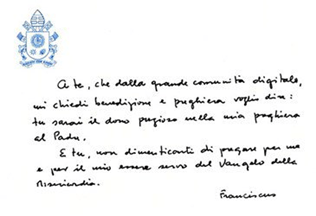
During the World Day of Telecommunications, already in 2016, the Holy Father transmitted his personal message to the great digital community of the planet, in his very own spontaneous way that always characterises him.
He did not dictate his message, nor did he type it or sound-recorded it or videotaped it; instead, he used the classical, “traditional’ and millennia-long well-tested method of putting pen on paper!
His hand-written message, then, was surely photographed and sent to the various social platforms of the Internet so that it could reach everyone everywhere.
It reads as follows;
To you, who from the great digital community, ask for my prayers and blessing, I wish to say that you will be the precious gift in my prayer to the Father. And you, don’t forget to pray for me so that I may be a servant of the Gospel of Mercy.
 Open Reflections