για Ελληνικά πατήστε εδώ
New aspiration
Being part of this amazing world, immersed into its beauty and its contradictions, its pain and its hopes, forever trying to move forward, to go further and to push higher we realize that we are not mere pawns on an immense interactive field, in an indifferent world that goes on despite us, but we are active contributors to its destiny.
Daniel was a “man of desires”, (Dn. 9, 23), and for that reason “pleasing to God”. We help shape and form this world according to our aspirations and desires.
Jesus, on whom the Father’s favour rests (Lk. 3, 22) desires the salvation of every one of us; he shows us the path to God and, at the same time, provides all the means that enable us to follow it.
When the Holy Spirit came down upon the Disciples, like wind and like fire, He blew new breath into them, (Acts 2, 2-3), and in their hearts and minds was born the strength and the desire to love the Lord above all.
The Church received this mission by the Lord, i.e. to reconcile mankind to God. Thus, a new creation takes place where man, reconciled to his Creator, strongly wills to spread the Good News, to share his faith and joy to the ends of the world and to inspire hope and charity everywhere.
Where the Spirit of God is present chaos gives way to order and to harmony, Gen. 1, 2); light and peace follow.
Listening to His voice and obeying we become pioneers of God in mankind’s struggle for a better world since we are in a position to instruct and to rebuild, to construct and to inspire, to nurture and to support; for we, as Christian, are not aspiring only to push the limits of the earthly horizons, but we fix our gaze to the world beyond where “God is all in all” in a new heaven and a new earth (Rev. 21, 1).
*
The concept of work…
…can turn into an exaggerated mystique. Yet, for all that, it is something willed and approved by God. Fashioned in the image of his Creator, “man must cooperate with Him in completing the work of creation and engraving on the earth the spiritual imprint which he himself has received.” God gave man intelligence, sensitivity and the power of thought—tools with which to finish and perfect the work He began. Every worker is, to some extent, a creator—be he artist, craftsman, executive, labourer or farmer.
Bent over a material that resists his efforts, the worker leaves his imprint on it, at the same time developing his own powers of persistence, inventiveness and concentration.
Further, when work is done in common—when hope, hardship, ambition and joy are shared—it brings together and firmly unites the wills, minds and hearts of men. In its accomplishment, men find themselves to be brothers.
Encyclical “Populorum Progressio” Pope Paul VI, May 1967, §27
Did you know…
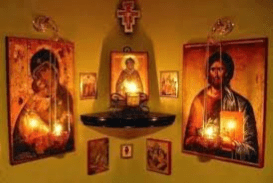
According to main-stream etymology, the word candle is derived from the Latin candela (from “candeo” = to shine, to burn).
There is, however, the theory that candle comes from the Greek word κανδήλη (kandele, pronounced kahn-thee-lee) from the words παν+δήλος (pan + delos) (pan = all and delos = manifest) with the letter “k” replacing the original “p”.
Hence, candle is that which makes things manifest (by shining) to all directions—In English, shine and show are most likely related.
Whatever the origin of the word, maintaining a lit candle in front of icons at a room corner of the house or even work-place, is a much-loved and popular practice among the Christian populations of the Orient and the Middle East.
So, next time we happen to stand in front of a lit candle, in a church or at home, let us bring to mind that the light it sheds in the darkness is, also, that of our faith. We must not only be keeping our faith alive but, also, making it manifest to a world that is really in dire need of it.
Three-fold responsibility

The Church’s deepest nature is expressed in her three-fold responsibility: of proclaiming the word of God (kerygma-martyria = preaching-witness), celebrating the holy sacraments (leitourgia = liturgy), and exercising the ministry of charity (diakonia = service).
These duties presuppose each other and are inseparable. For the Church, charity is not a kind of welfare activity which could equally well be left to others, but is a part of her nature, an indispensable expression of her very being. (Encyclical “God is Love”, §25).
If all the above seem rather academic, it is up to us to make them real, to render them concrete and tangible, for we all are the Church.
What witness do we give in our families, schools, offices and workplace?
How do we experience the life of the Church, i.e. how do we spend our Sundays and our great religious feasts? What place do the Sacraments hold in our daily strife for a better future?
And, finally, how do we relate to our fellow men and women in our immediate environment and to those further away?
Here lie three fields wide open to our action and contribution for the building up of the Church and the salvation of humankind.
You renew the face of the earth
Praise the Lord, my soul, Lord my God, you are very great; you are clothed with splendor and majesty.
The Lord wraps himself in light as with a garment; he stretches out the heavens like a tent and lays the beams of his upper chamber on the waters. He makes the clouds his chariot and rides on the wings of the wind.
He makes winds his messengers, flames of fire his servants.
He set the earth on its foundations; it can never be moved, how many are your works, Lord! In wisdom you made them all; the earth is full of your creatures.
All creatures look to you to give them their food at the proper time. When you give it to them, they gather it up; they are satisfied with good things.
When you hide your face, they are terrified; when you take away their breath, they die and return to the dust.
When you send your Spirit, they are created, and you renew the face of the earth.
(Psalm 104; 1-5, 24, 27-30)
An armful of roses

During the month of May, following a long tradition, we pay particular homage to the Virgin Mary. Hymns and thanksgiving are raised in her honour demonstrating this way our affection for Her who, full of grace and filled with the Holy Spirit, became the Mother of God and our own Mother too.
We hasten to her side and trust her to, always, be our Guide.
Like an armful of roses with which we adorn her image may we, at all times, entertain pure intentions and good thoughts, pronounce encouraging words and work out useful things.
Then we can hope to be “the pleasing aroma of Christ among those who are being saved and those who are perishing” (2 Cor. 2, 15).
Sancta Maria Mater Dei ora pro nobis peccatoribus
click here for Greekc
 Open Reflections
One thought on “Like wind and like fire”