για Ελληνικά πατήστε εδώ
…in our pocket
The Holy Father has repeatedly proposed to us to, always, carry a pocket edition of the New Testament and to everyday read a few lines from the Gospel.
The benefit of this practice will be our familiarisation with the truths of our faith, as well as our increased ability to make good use of the spiritual means and weapons at our disposal.
Once we get to know the sacred texts we will be in a better position to make the correct choices, which will eventually lead us closer to the life Christ wants for us.
The Lenten period is a privileged season for the renewal of our prayer life and for the reading of the Scriptures (Lectio Divina). Our more frequent celebration of the Sacraments, Holy Communion and Reconciliation, is a great means to this end.
Christian life has an inner cohesion; it is clarified and reinforced through the liturgical life of the Church.
The Christian way is Christ’s way and is expressed in the everyday events and preoccupations, in our work place and in our communities, in our difficulties and pain, in our successes and our trials.
If we place our experiences in the light of faith, then everything gets inserted in the bigger picture and gets full of meaning.
After the Cross is the Resurrection!
Let us trustingly turn to our God, Father, Son and Holy Spirit and thank Him for His loving plan of Salvation for each one of us and for the whole world!
The Stations of the Cross
During the Lenten period on every Friday the Church invites us to prayerfully follow the Lord on His way to Calvary.
This gives us an opportunity to examine our life under the sign of the Cross.
The Son of God, who became Son of Man took upon Himself all the sins of the world.
He freed us from the clutches of sin and death and opened up the way to the Resurrection, the true and unending life in God.
Lamb of God who took away the sin of the world, have mercy on us!
(Liturgical prayer dating from the 7th century)
“Mother Lent”

Popular piety and religiosity in Eastern Europe, including Cyprus, has paid particular attention to the preparatory period of the forty days before Easter.
Lent, as a time of preparation, calls us to turn with renewed ardour towards God, so that we may be spiritually renewed and live as best we can the mystery of Easter.
The Church, as always, offers us all the means and all the help necessary for our spiritual march.
The discipline of fasting, praying, almsgiving and studying the Word of God frees us from habits less profitable and opens up the vast horizon of God’s salvific plan.
Miracles do happen deep in our heart. We only have to let God be God and be led by His grace.
The Holy Eucharist, the Sacrament of Reconciliation, the Stations of the Cross on Fridays, and the liturgical texts of every day, all contributes to us rendered capable to celebrate with true gladness and joy the Resurrection of our Lord.
Above he Eastern European traditional representation of “Mother Lent”, a lady with no mouth (due to fasting), with her arms folded in prayer, with the cross on her chest (a reminder of the Passion of Christ) and with seven legs (each leg for each week in Lent).
The three pillars of Lent: fasting, almsgiving and prayer

The Lenten period invites us to live at a deeper and more concrete level the Paschal Mystery in our personal, family and social life.
During this time the Church proposes three paths to us as we march towards Easter: fasting, almsgiving and prayer.
Each one of the above are but means for conversion; fasting, however, aims directly at our modern culture of consumerism, helping us to control our lower appetites of the body and to embrace God’s will in our life.
Fasting means to learn to change our attitude towards the others and towards creation; we avoid the temptation to want to “devour” everything in order to satisfy our voracity.
We are, then, ready to suffer for love, which alone can fill our empty hearts.
In this manner our life will be enriched, giving way to our neighbour and to God.
(Pope Francis, Lent 2019)
Did you know…

At the beginning of the 3rd century the sign of the cross on the forehead was a well-established tradition during the initiation ceremonies to the Christian life; that is, during the celebration of Baptism, Confirmation and Holy Eucharist (Holy Communion).
This gesture is like an invisible “seal”, which indicates that the person on whom it is applied belongs to Christ.
Christians often repeat this gesture.
Nowadays, during the supreme act of worship in the Church, the Holy Eucharist, the faithful trace the sign of the cross on their forehead, lips and chest before the reading of the Gospel.
This triple gesture signifies that the Word of God enlightens our mind and spirit, leads our words and sanctifies our intentions.
Likewise, the sign of the cross before and after a prayer reminds us that we belong to God and that we pray in union with His Church.
Mediterranean, border of peace
In the northwest of Syria, a huge tragedy is unfolding.
From our Pastors’ heart, a strong appeal is raised to the actors involved and to the International Community:
To silence the sound of arms and to hear the cry of the little ones and the defenceless, so that calculations and interests are put aside, to safeguard the lives of civilians and of so many innocent children who pay the consequences.
Let us pray to the Lord to move hearts so that all are able to overcome the logic of confrontation, of hatred and of revenge, to rediscover themselves brothers and children of one Father, who makes the sun rise on the good and on the evil (Mt. 5:45)
Let us invoke the Holy Spirit so that each one of us may contribute, with daily gestures of love, to build new relations inspired in understanding, hospitality, and patience, thus setting down the conditions to experience the joy of the Gospel and to spread it in every environment of life.
(The Holy Father, speaking in Bari, Italy, at the meeting with the theme: “Mediterranean, border of peace”, 23/2/2020)
The Annunciation to Mary
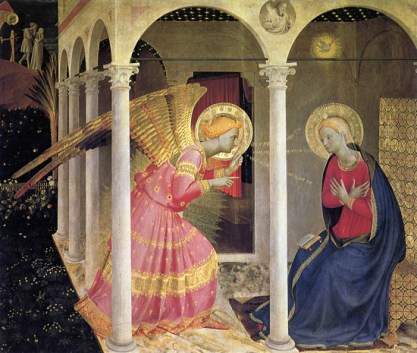
In that land there lived a maiden
—to us it has been often said—
this woman’s ancestry
was of faultless lineage:
she was born from Jesse’s stem.
When the angel went in,
this is how he began;
he said: “Ave gratia plena,
Greetings to you, Mary!
God wishes to dwell with you.
May you be blessed among other women!”
“Do not be afraid!
This is what I say to you:
You alone
have found favor with God.
Ecce concipies et paries filium.
He will be called God’s Son
and named Jesus.
At him the whole world will rejoice.
In truth he will be
a mighty savior.
“Spiritus sanctus will come over you.
He will overshadow your womb,
and you will have conceived a child.
I have more to tell you:
Elizabeth, your kinswoman,
who is in old age,
is to bear a child.
This is now the sixth month
since God’s will commanded it.
From this you can know
that nothing is impossible for God.”
Then Saint Mary said:
“About God I am free of doubt.
I believe his power
over young and over old.”
She said: “Ecce ancilla domini.”
According to your words may it happen to me.”
Excerpts from the poem by Frau Ava, 1060-1127), an anachorite (anchoress) from Melk, Austria.
She is the first woman writer in the German language.
The symbolism of oil
Sacred Scripture attests to the spiritual symbolism of oil.
For instance, Psalm 23:5 reads, “You anoint my head with oil,” signifying favour and strength from the Lord; and Psalm 45:8 reads, “You love justice and hate wickedness; therefore, God your God, has anointed you with the oil of gladness above your fellow kings,” signifying the special designation from God and the joy of being his servant.
Moreover, to be “the anointed” of the Lord indicated receiving a special vocation from the Lord and the empowerment with the Holy Spirit to fulfil that vocation:
Jesus, echoing the words of Isaiah, spoke, “The spirit of the Lord is upon me; therefore, He has anointed me” (Lk 4:18).
St. Paul emphasised this point, “God is the one who firmly establishes us along with you in Christ; it is He who anointed us and has sealed us, thereby depositing the first payment, the Spirit in our hearts” (2 Cor 1:21).
Therefore, the symbolism of oil is rich sanctification, healing, strengthening, beautification, dedication, consecration and sacrifice.
click here for Greek
 Open Reflections
One thought on “A treasure…”