
για Ελληνικά πατήστε εδώ
Christ meets his people
The feast of the Presentation of Jesus to the Temple, where the Lord meets His people in the person of the elderly Symeon and prophetess Anna, renders a particular “colour’ to the whole month of February, as it reminds us of Christ’s consecration to God the Father and His total self-giving for our salvation.
Symeon and Anna recognised the Lord for they were “righteous and devout” and ‘they were waiting for the consolation of Israel” (Lk. 2, 25).
In order to “hear” the Spirit’s promptings we must, also, be in a state of readiness. This way we shall be in a position to recognise the Lord‘s presence in our life’s events and live in accordance to His holy will.
The Infant Jesus is offered to the Heavenly Father and with Him the whole of humanity, which He wishes to save, is offered too.
Nevertheless, what does our consecration to God mean if not our willing obedience to His loving design?
The Church considers this feast as the feast of all those who have a particular consecration to God, namely the priests and religious (monks and nuns).
All the baptised, however, make up the consecrated people to God and are God’s People.
Our Baptism, that is our birth in the life of Christ, is our personal consecration to Him, for
“Our eyes have seen His salvation, which He has prepared in the sight of all people, a light of revelation to the nations and for glory to His people Israel” (Lk. 2, 30-32).
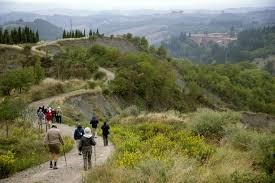 The spiritual life is an adventure and a march, so to speak, which begins with our Baptism and has as its final destination none other than our full communion with God the Father, Son and Holy Spirit.
We are God’s children and called to live united to Him, loving Him and loving our fellow men and women.
Christ through His Church gives us all the means to this goal.
The Church is, through the Sacraments, the ordinary” place and space’ of grace and sanctification.
In this march we are not alone. The Mother of our Saviour, the Most Holy Virgin Mary is on our side interceding for us. Let us never hesitate to implore her maternal help.
None who has recourse to Thee. Oh pure Virgin Mother of God. Leaves your side unaided, but as he asks the favour he receives the gift to the good of his soul.
(Much-loved liturgical prayer of the Oriental Church
The house of Peter
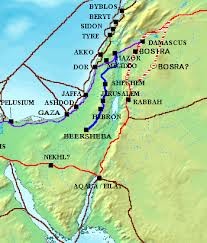 The ancient city of Capharnaüm is situated on the northwestern bank of the lake of Tiberias and at a distance of four kilometres from the river Jordan, on the “Via Maris”, i.e. the “Maritime Way”, which connected Syria’s Damascus with the coastal Caesarea and Lebanon’s Tyre with Egypt. (See the map).
At these crossroads the Roman authorities, at the time of Christ, collected customs taxes, because that was a much-frequented route with developed trade.
Saint Matthew the Evangelist used to work there before he abandoned everything in order to follow Christ.
Archaeological excavations brought this to light circa 1800.
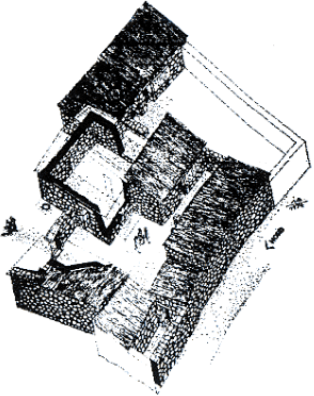
More recently, in 1968, the house of Apostle Peter was discovered. (see plan below on the right).
Over the original building, which had been converted to a place of worship by the first Christians already in the 1st century, an octagonal basilica was built in the 5th century.
On the walls of the house of Peter graffiti was found; 131 inscriptions in total in four languages: Greek, Aramaic, Syriac and Latin. They were made by the pilgrims who engraved short prayers or supplications, like, for example, “Lord Jesus Christ have mercy on your servant…” et al.
Christs performed many miracles in Capharnaüm which are mentioned in the Gospels.
Engraved upon the stone and the heart
Archaeological finds in Nazareth have discovered, among other things, inscriptions (graffiti) of the first century on walls with the words “XAIΡE MAΡIA” that is “Ave Maria”.
They are part of the irrefutable evidence regarding the love and devotion the first Christians displayed towards the person of the Mother of God, engraved upon the stone and upon their hearts too; and that is a fact from the very beginning in the existence of the Church (Acts, 1, 14).
One of the most ancient written prayers to the Virgin Mary, dating from the third century, was found on a papyrus.
It is written in Greek, and here is the translation:
Under thine mercifulness do we find refuge, Oh Mother of God.
Our supplications do not disregard in our circumstances, but from all danger deliver us, Oh only Pure and Blessed Virgin Mary!
Did you know…
The Church’s care for the sick, faithful to her Lord’s law of love, caused —as time went on, a real revolution in the conscience of the populations where Christianity was present.
The First Ecumenical Council in Nicaea in 325, not only did it give us the “Symbol of Faith”, i.e. the “Credo”, but, among other things, ardently promoted the care of the poor, the sick, the widows and orphans and the strangers.
The Council decreed the building and operation of a hospital in every city in which there was a Cathedral, i.e. in every city where a Bishop had his seat.
Among the first Christian hospitals was that of Doctor Samson (†530) in Constantinople, which functioned for 600 years, and the one of Saint Basil (330-379) in Caesarea of Cappadocia (different from the coastal city of Caesarea); it was adjacent to a monastery and offered shelter to the poor and to travellers as well as health care to the sick and weak. A little further away there was a department dedicated to the care of the lepers.
In Medieval Europe many were the religious communities, both of men and women that looked after the sick, and the Church’s charity remains active and radiant and a model for imitation even in our days.
Communion and sharing

Life is communion and sharing.
The progress of one person contributes to the progress of the whole and, also, the stagnation of one leads to the increase of the stagnation of all.
The above statement must not surprise us. We all share in the one human nature, therefore we are all connected whether we are aware of that or not.
Likewise, what holds true on the physical plane holds true on the spiritual plane too.
The Church says it clearly: all the baptised are members of the Mystical Body of Christ, therefore we are connected to each other with very real, strong and spiritual bonds!
Whatever we do, good or bad, has consequences and affects the whole body.
Let it be noted, however, that we receive from the Body of Christ our spiritual life as well as all means for its protection, healing and growth.
The Mystical Body of Christ is the Church!
The Incarnation of the Son of God is the “bridge” that connects man to God, the earthly to the divine, the creature to his/her Creator.
The access to God, the eternal striving of humanity to reach Him, its hidden desire and aspiration throughout history has now become possible, constant, and effective.
The gap has been bridged and that “bridge” has been “built” for our sake!
Our Lady of Lourdes
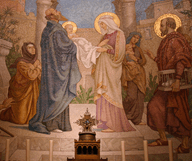
Our Lady of Lourdes is one of the most renowned places of pilgrimage in the world, with an impressive list of miraculous cures for which science has no explanation.
The number of the pilgrims is certainly greater than the number of the known cases of miraculous healing. However, it suffices one encounter with some of the pilgrims in order to ascertain that there is another type of healing at a deeper level that cannot be “seen”.
It is the inner peace, the deep and renewed trust in God’s love, the hope which may be translated into a novel way of life in giving and gratitude and, most importantly, it is the courage to not give up our daily striving to live out our Christian Baptism.
Having brought with confidence our problems and weaknesses to the Mother of the Redeemer we return strengthened and enriched with gifts that are “unseen” to the eyes of the world; and this is our personal “secret”.
So, our pilgrimage to Lourdes, (or to any other place for that matter), becomes a springboard to a new beginning.
In the heart of the Pyrenees we open our heart to the grace of God!
The Church of Cyprus

The Church of Cyprus is administratively part of the Diocese of Jerusalem. It belongs to the Latin Patriarchate of Jerusalem.
Head of the Church of this province, which consists of the Holy Land, Palestine and Israel, Jordan and Cyprus, is the Archbishop Mgr. Pier Battista Pizzaballa whose seat is in the Holy Land.
The |Apostolic Vicar for Cyprus is currently the reverent father George Kraj o.f.m. whose seat is in Nicosia.
Quite regularly both the Archbishop as well as the Apostolic Vicar come here in Paphos and it is with great joy we receive them on their pastoral visits.
The Church is the meeting-place par excellence between God and His people and of course between the faithful and their pastors and the pastors with each other.
All of us united with the Bishop of Rome, i.e. the Roman Pontiff and Successor of Peter, the Pope are a living part of the Mystical Body of Christ, the Catholic Church.
The photo above is taken on June 4th, 2010 during the Apostolic visit of Pope Benedict XVI to Cyprus and to Paphos. The church dates from the 15th century.
May each encounter be a union of hearts too!
click here for Greek
 Open Reflections
One thought on “We are not alone”