
για Ελληνική πατήστε εδώ
All Saints: Love for Love
All Saints! Who are they? Why do we dedicate a feast day to them?
They are all the men, women and children of all ages, who have lived near God, but remain “hidden” and unknown.
They are, also, the contemporary men, women and children who, today, live in close proximity to Christ and His Church.
It is the man next door, the conscientious worker, the mother who builds up her children’s spiritual life, he who in silence prays for his neighbour and comes to his aid whenever necessary; it is the grandma who teaches her grandchildren to love God and to pray; he who consumes himself in the care of the sick; the poet who writes inspiring poems which uplift the spirit of those who read them, the composer whose music leads us straight to acknowledge God’s majesty and the beauty of His Creation; he who generously shares his bread and his time with those who need them; he who becomes the voice of those who cannot defend themselves, i.e. the oppressed, the abandoned, the unborn, the sick, the wronged….
The list goes on…
What would the common ground be of all these people mentioned above?
Their common ground is that they have freely given their priority to God’s Word.From Him they draw the strength to love, to not be afraid, to not give up, to not complain and to give their all.For, having experienced in their lives the immeasurable love of God, they in gratitude simply respond Love for Love!
The Ministry of Reconciliation
Therefore, if anyone is in Christ, he is a new creation; old things have passed away, and look, new things have come.
Everything is from God, who reconciled us to Himself through Christ and gave us the ministry of reconciliation:
That is, in Christ, God was reconciling the world to Himself, not counting their trespasses against them, and He has committed the message of reconciliation to us.
Therefore, we are ambassadors for Christ, certain that God is appealing through us.
We plead on Christ’s behalf, “Be reconciled to God.”
(2 Cor. 5, 17-20)
This is close to the heart of the Successor of Peter, our Pope Francis who, true to his calling, reminds all and everyone that we must live in peace with each other.
Saint Albert the Great
 Albert the Great was born before 1200 in nowadays Bavaria. He died in Cologne in 1280.
He initially studied at the University of Padua; he studied all the works of Aristotle, which led him to enter Holy Orders (1223?) becoming a Dominican. He became a Master of Theology and taught in many universities.
In 1260 Pope Alexander IV made him Bishop of Regensburg. During the exercise of his duties he, by humility, refused to ride a horse, instead traversing his huge diocese on foot. People loved and revered him for his virtues as well as for his erudition.
Albert was the first to comment on virtually all of the writings of Aristotle, thus making them accessible to wider academic debate.
The study of Aristotle brought him to study and comment on the teachings of Muslim academics, notably Avicenna and Averroes, and this would bring him into the heart of academic debate.
His writings collected in 1899 reach thirty-eight volumes. They display his prolific encyclopedic knowledge of topics such as logic, theology, botany, geography, astronomy, astrology, mineralogy, alchemy, zoology, physiology, phrenology, justice, law, friendship, and love.
He digested, interpreted, and systematised the whole of Aristotle’s works, gleaned from the Latin translations and notes of the Arabian commentators, in accordance with Church doctrine. Most modern knowledge of Aristotle was preserved and presented by Albert. He was canonised in 1931 and is also named Doctor of the Church.
Saint Thomas Aquinas was a student of Albert the Great.
Albert the Great has said…
“It is by the path of love, which is charity,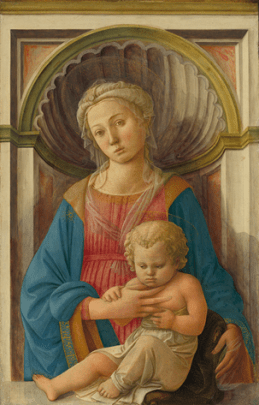
that God draws near to man and man to God.
But where charity is not found, God cannot dwell.
If, then, we possess charity, we posses God,
for ‘God is Charity’
“Above all, one should accept everything,
in general and individually, in oneself or in others,
agreeable or disagreeable,
with a prompt and confident spirit,
as coming from the hand of His infallible Providence
or the order He has arranged.”
“The surest and quickest way
to attain perfection, is to strive,
for purity of heart.
Once the obstacles have been removed,
God finds a clear path and does wonders,
both in and through the soul.”
“Mary is the Divine Page
on which the Father
wrote the Word of God,
His Son.”
Above right: Madonna and Child, tempera on poplar panel by Fra Filippo Lippi, c. 1440; in the National Gallery of Art, Washington, D.C. 79 × 51.1 cm.
Did you know…
 The terms Near East and Middle East denote the same territories and are generally accepted as comprising the countries of the Arabian Peninsula, Cyprus, Egypt, Iraq, Iran, Israel, Jordan, Lebanon, Palestinian territories, Syria, and Turkey.
In Ancient Mesopotamia, i.e. the region between the rivers Tiger and Euphrates, (in modern-day Syria and Iraq), we have the first known cities –since 5,000 B.C., effective and extensive irrigation systems, observatories (the ziggurat) which served also as temples, the first written texts and state legislation.
Always, the populations of the Near East practiced various religious beliefs, usually protected and promoted by their respective king/ruler.
Nowadays, the main religions in the region are Islam, Christianity and Judaism, but other less well-known religious communities survive like the Baha’i, Zoroastrians, Yazidi as well as multiple smaller isolated groups scattered in villages of Iran, Northern Syria, Lebanon (e.g. the Druse) and elsewhere.
Fight the good fight
Pope Francis warns us to not turn our faith into an ideology, as St Paul did when he was persecuting Christians before his conversion.
St Paul, called Saul before his conversion, was “an ideologist; for Saul, religion had become ideology, religious ideology, social ideology, political ideology” .
Reflecting on Saul’s behaviour toward Christians is a chance for everyone to consider how we are living our faith: “How do I live my life of faith? Am I going to meet others or am I against others? Do I belong to the universal Church?.., good, bad, everyone? Or do I have a selective ideology?”
“Do I love God, or do I love dogmatic formulations?” “How is my religious life? Does the faith in God that I profess make me friendly or instead hostile to anyone who is different from me?”
The young Saul is portrayed as intransigent, that is, one who shows intolerance towards those who think differently from him…
But while Saul is chasing down Christians, Christ is chasing down him. The Lord appears to Saul as light and voice on the road to Damascus, saying: “Saul, Saul, why do you persecute me?” for to strike a member of the Church is to strike Christ himself.
Only through Christ does Saul’s transformation takes place. Then he will teach that the true battle ‘is not against flesh and blood, but against […] the rulers of this dark world, against the spirits of evil.” (Eph. 6)
Saul will go on to teach, that “people should not be fought, but the evil that inspires their actions.”
Saul then receives baptism, which marks for him, as for each of us, the beginning of a life. The sacrament helps him to see God, himself, and others differently. His enemies become brothers in Christ.
(Pope Francis, 9 Oct. 2019, excerpts)
O Lover of all souls!
And in return of their senseless wicked thoughts, which misled them into worshipping dump serpents and worthless insects, You sent upon them swarms of dump creatures for vengeance; that they might recognise that a man is punished by the very things through which he sinned
But you have disposed all things by measure and number and weight. For with you great strength abides always; who can resist the might of your arm?
Indeed, before you the whole universe is as a grain from a balance, or a drop of morning dew come down upon the earth. But you have mercy on all, because you can do all things; and you overlook the sins of men that they may repent.
For you love all things that are and loathe nothing that you have made; for what you hated, you would not have fashioned.
And how could a thing remain, unless you willed it; or be preserved, had it not been called forth by you?
But you spare all things, because they are yours, O Lord and lover of souls, for your imperishable Spirit is in all things!
(Book of Wisdom, ch. 11: 15, 16 and 20– ch. 12: 1).
The truth will set you free (John 8, 32)
 “The Word is equivalent to the spoken Truth.
If things are spoken into Being through Truth then they are good!
Then what you have to decide is: if you speak the Truth, then what happens is Good, regardless of what happens.
And that is faith.”
The quotation is from the contemporary Christian intellectual, Jordan Peterson.
Jordan Peterson is Professor of Psychology at the University of Toronto, Canada and a clinical psychologist.
He defends faith in God and in Christ and he is a bold opponent of ideologies which he sees as substitutes for true knowledge.
Although not a Catholic, we recognise in him echoes of our common faith through our Baptism, and struggle —-with the grace of God, for a better world based on reconciliation with and through the Truth.
click here for Greek
 Open Reflections
One thought on “You love all things”