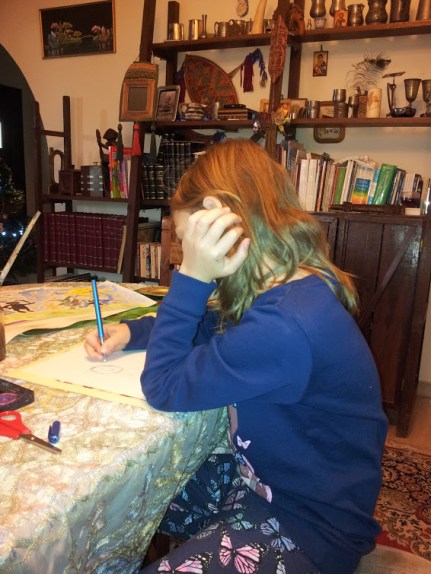
A little game
Finding ourselves in the heart of summertime we may dispose of some more free time than usual; let us then play a little game:
In the course of our day, let us pause a couple of times just for a minute and examine what it is that we are thinking at that particular point in time.
This way we become aware of the pattern of our thoughts/words.
If the thoughts which emerge are mostly positive, e.g. satisfaction, expectation, optimism, all is well, trust in God, companionship, pleasure etc. then we bathe in an atmosphere which supports and encourages us toward our goals.
If, on the contrary, our first thoughts/words are negative like fear, worries, antipathy or even hatred against a situation or a person, then it will be wise to try and control our thoughts so that we may overall be happier.
The words we utter reveal our thoughts and to a great extent shape our mentality (pattern of thinking).
It makes sense then to seek out whatever “nourishes” our positivity.
Our spiritual health and clarity depend also on what we allow to enter into our mind, that is they depend upon our habitual thoughts and vocabulary, the books we read, the TV programmes we follow, the friends and companions we keep, and most certainly, upon our personal relationship to God and His Church.
The Word of God is always actual, alive and life-giving!
Let us allow Him, even better, let us invite Him to enter our minds and our hearts.
My delight is in the law of the Lord
Blessed is the one
who does not walk in step with the wicked
or stand in the way that sinners take
or sit in the company of mockers,
but whose delight is in the law of the Lord,
and who meditates on his law day and night.
That person is like a tree planted by streams of water,
which yields its fruit in season
and whose leaf does not wither—
whatever they do prospers.
Not so the wicked!
They are like chaff
that the wind blows away.
Therefore the wicked will not stand in the judgement,
nor sinners in the assembly of the righteous.
For the Lord watches over the way of the righteous,
but the way of the wicked leads to destruction.
Psalm 1
God is Father
By calling God “Father”, the language of faith indicates two main things: that God is the first origin of everything and transcendent authority; and that he is at the same time goodness and loving care for all his children.
God’s parental tenderness can also be expressed by the image of motherhood which emphasisesawareness
God’s immanence, the intimacy between Creator and creature. The language of faith thus draws on the human experience of parents, who are in a way the first representatives of God for man.
But this experience also tells us that human parents are fallible and can disfigure the face of fatherhood and motherhood. We ought therefore to recall that God transcends the human distinction between the sexes. He is neither man nor woman: he is God. He also transcends human fatherhood and motherhood, although he is their origin and standard: no one is father as God is Father.
Jesus revealed that God is Father in an unheard-of sense: he is Father not only in being Creator; he is eternally Father by his relationship to his only Son who, reciprocally, is Son only in relation to his Father: “No one knows the Son except the Father, and no one knows the Father except the Son and any one to whom the Son chooses to reveal him.”
Catechism of the Catholic Church, § 239 and 240.
(Bolt typing and underlining by the editor)
Saint Augustin of Hippo

Born in Thagaste, nowadays Souk-Ahran in Algeria, in 354, Augustin was a Romanized Berber of a well-to-do family.
His mother, Saint Monica, was Christian and prayed hard for many years for his conversion.
At the age of 31, after a tumultuous itinerary, he converts and gets finally baptised in Milan, in 387, by the bishop Saint Ambrose.
In 391 he is ordained priest and becomes a famous preacher. There are more than 350 preserved sermons of his, rich in theological and philosophical depth.
In 395 he becomes bishop of Hippo (North Africa) until his death in 430, one year after the Vandal invasion of the region.
In 410 the Western Roman Empire falls under the constant pressure of the Barbaric invasions.
He wrote influential works which have marked our European thought and civilisationRoman, like the ’City of God” and his “Confessions”.
He is one of the four Latin Fathers of the Church, together with Saint Ambrose, Saint Jerome and Pope Gregory the Great.
On the right, the earliest known portrait of Saint Augustine in a 6th-century. Fresco, Lateran, Rome
Did you know…
Since the earliest times of our Church, we have used the title “Father” for religious leaders. Bishops, who are the shepherds of the local Church community and the authentic teachers of the faith, were given the title “Father.” Consequently, St. Peter may well have been addressed as “Father Peter,” in that sense of spiritual father.
The likelihood of this address is supported by St. Paul who identifies himself as a spiritual father. In writing to the Corinthians, he said, “I am writing you in this way not to shame you but to admonish you as my beloved children. Granted you have ten thousand guardians in Christ, you have only one father. It was I who begot you in Christ Jesus through my preaching of the Gospel. I beg you, then, be imitators of me. This is why I have sent you Timothy, my beloved and faithful son in the Lord” (1 Cor 4:14-17).
Until about the year 400, a bishop was called “father” (“papa”); this title was then restricted solely to addressing the Bishop of Rome, the successor of St. Peter, and in English was rendered “pope.”
Queen of Heaven
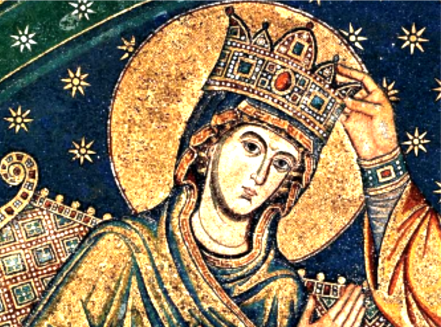
In 1954, Pope Pius II with his encyclical “Ad Caeli Reginam” establishes the annual feast of BMV Regina on 22nd August.
n this encyclical we are reminded that Mary is Queen, first of all, as the Mother of Christ the King, and then because by her intercession she is our ally in battle in all our personal and collective / ecclesiastical strives as Christians.
This relationship between the Mother of God and her Son’s Church is also expressed in the 21st Ecumenical Council (Vatican II):
“The faithful should remember that authentic piety is neither sterile passing sentimentalism nor thoughtless credulity, for its origin is authentic faith; authentic faith leads us to the recognition of the paramount importance of the Mother of God, and awakens in us the desire to love her as children loving our Mother, and to imitate her virtues”.
For the man/woman of Faith, the Church is the international people of God, who painstakingly but constantly advances through the ages towards the end of History and the final Restoration of all and everything in Christ.
Late have I loved Thee
Late have I loved Thee, O Lord; and behold,
Thou wast within and I without, and there I sought Thee.
Thou wast with me when I was not with Thee.
Thou didst call, and cry, and burst my deafness.
Thou didst gleam, and glow, and dispel my blindness.
Thou didst touch me, and I burned for Thy peace.
For Thyself Thou hast made us,
And restless our hearts until in Thee they find their ease.
Late have I loved Thee, Thou Beauty ever old and ever new.
These lines are taken from Saint Augustin’s (354-430 A.D) “Confessions”.
It is a classic work of Christian theology, and a model in the history of autobiography.
It is a work full of gratefulness and repentance.
Although it is biographical it deals, among others, with themes such as the nature of time, causality and the free will.
From the Father’s hand
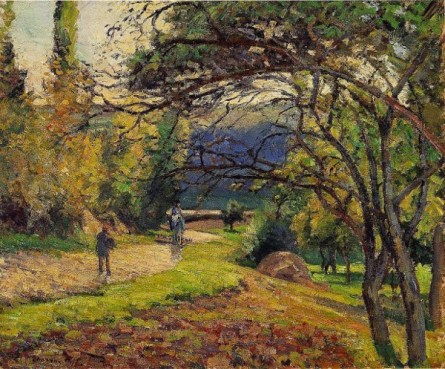
A spirituality which forgets God as all-powerful and Creator is not acceptable.
That is how we end up worshipping earthly powers, or ourselves usurping the place of God, even to the point of claiming an unlimited right to trample his creation underfoot.
The best way to restore men and women to their rightful place, putting an end to their claim to absolute dominion over the earth, is to speak once more of the figure of a Father who creates and who alone owns the world. Otherwise, human beings will always try to impose their own laws and interests on reality.
In the Judaeo-Christian tradition, the word “creation” has a broader meaning than “nature”, for it has to do with God’s loving plan in which every creature has its own value and significance.
Nature is usually seen as a system which can be studied, understood and controlled, whereas creation can only be understood as a gift from the outstretched hand of the Father of all, and as a reality illuminated by the love which calls us together into universal communion.
Pope Francis, Encyclical Laudato si’ (May 2015), §75 and 76.
 Open Reflections