για Ελληνικά πατήστε εδώ
Our life’s protagonist
On Pentecost Day the Apostles, not only cease to be fearful and remain hidden, but with great courage they preach, to whomever wishes to listen to them, the Good News of Christ’s resurrection and the forgiveness of sins in His name.
This outward “movement” of the Church, which started on that day, never stopped!
And, it could not have stopped for the moving force behind it is the very Spirit of God!
The Spirit is and remains the protagonist of our spiritual life!
He is the fire that purifies and warms up, the fire that sheds light and sanctifies, the fire that burns all obstacles and spreads far and wide.
He is the water that overflows and cleanses, the water that quenches our thirst and makes life possible.
He is the air we breathe, the wind that takes us up in his movement and brings us to God’s embrace.
He is the love that inspires us, the inner voice that guides us, the grace that surrounds us.
The Spirit of God is life and He is power!
So, we pray with the Church everywhere and at all times:
“Come, Holy Spirit, fill the hearts of your faithful, and kindle in them the fire of your love.”

Today you send the Holy Spirit
Father, all-powerful and ever-living God, we do well always and everywhere to give you thanks.
Today you sent the Holy Spirit to those marked out to be your children by sharing the life of your only Son, and so you brought the paschal mystery to its completion.
Today we celebrate the great beginning of your Church when the Holy Spirit made known to all peoples the one true God, and created from the many languages of man one voice to profess one faith. The joy of the resurrection renews the whole world, while the choirs of heaven sing for ever to your glory.
(From the liturgy of the Church on the day of Pentecost)
Kitium / Larnaca
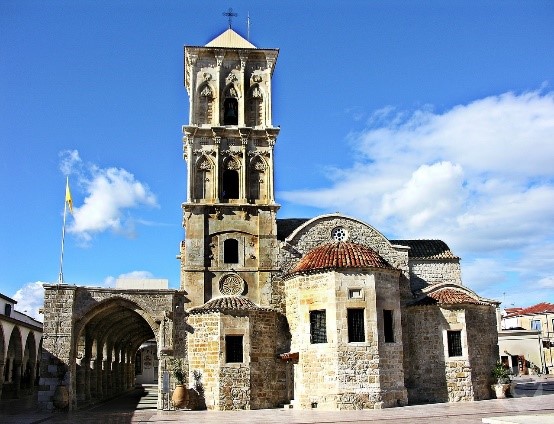
The church of Saint Lazarus in Larnaca.
Cyprus is one of the first lands beyond Palestine which received the Christian Faith.
Because of its geographical proximity to the Holy Land that was natural and fair.
Saint Paul, Saint Barnabas, (of Cypriot origin), and Saint Marc the Evangelist traveled to Cyprus for the first time in 45 A.D. and brought the Gospel to her inhabitants.
There is, also, a tradition that Lazarus, the friend of Jesus and the brother of Mary and Martha, settled in Kitium in eastern Cyprus and died there.
His sarcophagus, until the 9th century, was at the city of Kitium; in the 9th c. it was offered as a gift to the church in Constantinople.
Another word for “sarcophagus” in Greek is “Larnax” (Genitive: of Larnacos, Accusative: to Larnaca).
So, overtime the name “Larnaca” prevailed and replaced the name of Kitium, pointing to a strong Christian presence.
In modern-day Larnaca there is the very old church of Saint Lazarus; in its catacombs one may see where the saint’s sarcophagus used to be. The church combines various architectural styles from different periods in time with most pleasing effects.
Contemporary Apostolic journey to Cyprus

The ecumenical celebration at Aghia Kyriaké / Panaghia Chrysopolitissa, 4 June 2010
The most recent Apostolic journey to Cyprus took place in June 2010.
The Successor of Peter arrived to the “Island of the Saints” not from the land of Palestine, but from the Eternal City, that is from Rome.
The aim of the Pontiff’s journey had been to make a personal pilgrimage on the footsteps of Saint Paul.
In his speech on ecclesiastical communion and on the path towards unity, pronounced at the archaeological site of the Church of Aghia Kyriaké / Panaghia Chrysopolitissa in Paphos, during an ecumenical celebration, the Holy Father thanked the Orthodox Archbishop of Cyprus, Chrysostomos II, for having worked so hard in favour of this visit. The Holy Father emphasized this fundamental truth which relativizes all divisions: “The Truth is Jesus Christ”.
Did you know…
The Spirit undivided from the Father and the Son has his own way of revealing himself. In all languages, his name is a noun taken from the natural phenomena of wind and breath. (Hebrew ruâh, Latin spiritus). So, we have an image of the divine respiration whose rhythm regulates the seasonal change, but, also, the effusion of the Spirit who vivifies the hearts. It is impossible to possess the Spirit: “you hear his voice”, but you cannot know “whence he comes and where he goes” (John 3, 8).
He renews the face of the earth, however, his action begins from within and it is from within he is known: “You have known him for he lives in you” (John 14, 17). The great symbols of the Spirit, water, fire, air and wind belong to the natural world and have no definitive form. They basically express the invasion of a presence, an invincible expansion and, always, in depth. The Spirit is neither less nor more mysterious than the Father and the Son, but he strongly reminds us that God is the Mystery, and prevents us from forgetting that “God is Spirit” (John 4, 24) and “The Lord is the Spirit” (2 Cor. 3, 17).
Dictionary of Biblical Theology, Paris 1971
God’s gifts
The primal reality of biblical history is the gifts of God, which are freely given and without reciprocity.
Meeting with God places man in front of the Absolute, but at the same time, perfects him and transforms his life.
The thanksgiving appears as the response to this progressive and continual grace, that one day will reach its fullness in Christ.
The thanksgiving act signifies awareness of God’s gifts; it is the purest form of a soul, ecstatic and overflown with joy and gratefulness for the generosity and magnificence of God.
The act of thanksgiving is, therefore, essential in the Bible, as a fundamental religious response of the creature which discovers, in a thrill of joy and awe, something of the greatness and glory of God.
The principal sin of the pagan was, according to Paul, that “neither glorified Him as God nor gave thanks to Him” (Rom. 1, 21).
Indeed, among the great number of hymns created by the piety in ancient Mesopotamia, the act of thanksgiving is the exception while it is frequent in the Bible, causing great enthusiasm.
*
The New Testament is the revelation and gift of perfect grace in Jesus Christ of the perfect thanksgiving act offered to the Father in the Holy Spirit.
This perfect thanksgiving act (“Eucharist” in Greek) is none other than the sacrifice on the cross of the Incarnate Word of God, which the Church continues / re-enacts bloodlessly to the end of times and which the source of all grace is.
From the Eastern Church
Heavenly King, Consoler, the Spirit of Truth, present in all places and filling all things, the Treasury of blessings and the Giver of life, come and dwell in us, cleanse us of all stain and save our souls, O Good One.
It is with this prayer that every Mass in the Eastern Church begins.
Saint John’s Chrysostom’s mass is the standard Mass of the Byzantine Church since the 4th century.
This short prayer, also, is the prayer all students would recite at school at the start of the day.
It orientates the life and activity of the faithful to Him who bestows all blessings and all grace in the name of Christ and leads all to the Father.
It reminds us that God is ever-present everywhere and there is no place “hidden” from His presence.
The Holy Spirit is our guide, our consoler and our life!
Communion “in sacris”
The Eastern churches that are not in full communion with the Catholic Church celebrate the Eucharist with great love,
“These Churches, although separated from us, yet possess true sacraments, above all-by apostolic succession—the priesthood and the Eucharist, whereby they are still joined to us in closer intimacy.”
A certain communion in sacris, and so in the Eucharist, “given suitable circumstances and the approval of Church authority, is not merely possible but is encouraged.
When, in the Ordinary’s judgment, a grave necessity arises, Catholic ministers may give the sacraments of Eucharist, Penance and Anointing of the Sick to other Christians not in full communion with the Catholic Church, who ask for them of their own will, provided they give evidence of holding the Catholic faith regarding these sacraments and possess the required dispositions.
(Catechism of the Catholic Church, § 1399 and 1401)
click here for Greek
 Open Reflections
One thought on “Come Holy Spirit”