
για Ελληνικά πατήστε εδώ
The month of the Virgin Mary
May 2019
Having celebrated Easter and still lingering in its joyous and uplifting atmosphere, even nature seems to be participating in this feast.
We are in the midst of springtime and all converge into reminding us the wondrous and beyond comprehension love of God for us: the lush new foliage, the green fields, the full to the brim water dams, the flowering gardens, the amazing sunrises and sunsets, the warm breeze, our walks in town or in the countryside, our happy plans for the summer which is near.
In this general jubilation the People of God turn with particular gratitude to the Mother of Christ, whom God has given to us to be our Mother too!
So the Church has dedicated the whole month of May to the Virgin Mary.
Innumerable prayers and hymns have been written in her honour!
How many daily gestures of love and affection towards her are but a dim indication of the attachment of the faithful to her person! Her icon is never absent from a Christian home and many are the flowers offered her!
However, among all those expressions of filial love towards the Mother of God none surpasses the simple and spontaneous communication / prayer to her.
Our Lady is the Mother of our family, the Mother of our Church and the Mother of all Humanity!
She intercedes for us and always leads us to her Son!
Hail Mary, full of grace!
Let our hearts be lifted up
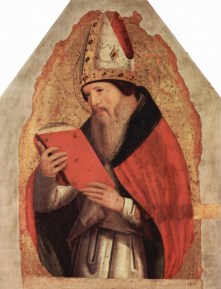 Today our Lord Jesus Christ ascended into heaven; let our hearts ascend with him.
Listen to the words of the Apostle: “If you have risen with Christ, set your hearts on the things that are above where Christ is, seated at the right hand of God; seek the things that are above, not the things that are on earth.”
For just as he remained with us even after his ascension, so we too are already in heaven with him, even though what is promised us has not yet been fulfilled in our bodies….We cannot be in heaven, as he is on earth, by divinity, but in him, we can be there by love.
(Saint Augustin of Hippo, (4th-5th c.) Sermon on the Ascension)
Saint Augustin of Canterbury
In the late 6th century, a man was sent from Rome to England to bring Christianity to the Anglo-Saxons. He would ultimately become the first Archbishop of Canterbury, establish one of medieval England’s most important abbeys, and kick start the country’s conversion to Christianity. Who was St Augustine, and how did his mission succeed?
Almost nothing is known of the early life of the man who brought Christianity to medieval England. Augustine was most likely living as a monk in Rome when in 595, Pope Gregory the Great chose him to lead a mission to convert the pagan Anglo-Saxons to the Christian faith. Christianity had been present in England during Roman times, but with the arrival of the Saxons, most of the country had once again reverted to paganism.
England in the 6th century was divided into many warring kingdoms. Of these, it was Kent that was chosen as the place to begin Augustine’s mission in England, most likely because of the powerful position of its ruler, King Æthelberht.
King Æthelberht did not immediately convert to Christianity, but he did treat Augustine and his companions with hospitality. They were given freedom to preach and invited to reside in Canterbury, the capital of Kent. Augustine and his companions held services in the ancient church of St Martin’s, which is believed to be the church that Queen Bertha herself worshipped in.
Eventually, King Æthelberht did convert, and the abbey of St Peter and Paul (later rededicated to St Augustine) was founded in Canterbury in about 598. Augustine became the first Archbishop of Canterbury, a role that to this day is still the most senior cleric in the Church of England.
(Source: http://www.english-heritage.org.uk)
Archbishop Saint Thomas Becket
 In 1162 Thomas Becket was appointed Archbishop of Canterbury by King Henry II.
Becket became a strong defender of the Church and her rights against the king’s infringements.
Becket also enjoyed the wide support of the people.
King Henry, however, wanted to get rid of this “turbulent priest”, so on 29 December 1170 four knights loyal to the Crown entered the Cathedral and brutally murdered the Archbishop.
Almost immediately after his martyrdom Pope Alexander III canonized Thomas Becket, in 1173.
His feast day is December 29.
T. S. Eliot (1888-1965) the Catholic poet and dramatist has written the well-known wonderful verse drama referring to the sad events of 1170 A.D. by the title “Murder in the Cathedral”.
For those who love poetry it is highly recommended.
Did you know…
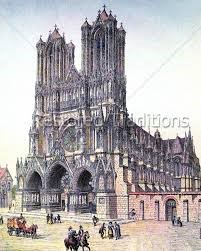 The Notre Dame Cathedral in Paris took about one hundred years to be built (1160-1260).
The Cathedral of Cologne took 632 years to complete! (1248-1880).
The Cathedral at Reims needed 124 years (1211-1345).
La Sacrada Familia in Barcelona began in 1882 and it has not been completed yet 137 years later. It is estimated that it will be finished in the next ten years.
The Cathedral took its name from the Greek word Cathedra (Καθέδρα) which signifies “seat” in the sense of “see”, of the Base and Headquarters of the Bishop.
There are as many cathedrals as there are bishoprics.
Europe boasts some of the most ancient and finest cathedrals in the world.
They are among the most visible and tangible living expressions of the creed of the People of God throughout history, and monuments of faith and beauty. (Above, the Cathedral at Reims, France)
Love moves the Universe
The word “creation” has a broader meaning than “nature”, for it has to do with God’s loving plan in which every creature has its own value and significance. Nature is usually seen as a system which can be studied, understood and controlled, whereas creation can only be understood as a gift from the outstretched hand of the Father of all, and as a reality illuminated by the love which calls us together into universal communion.
“By the word of the Lord the heavens were made” (Ps 33:6). This tells us that the world came about as the result of a decision, not from chaos or chance, and this exalts it all the more.
The creating word expresses a free choice. The universe did not emerge as the result of arbitrary omnipotence, a show of force or a desire for self-assertion.
Creation is of the order of love. God’s love; it is the fundamental moving force in all created things: “For you love all things that exist, and detest none of the things that you have made; for you would not have made anything if you had hated it” (Wisdom 11:24).
Every creature is thus object of his love, and in its few seconds of existence, God enfolds it with his affection. Saint Basil the Great described the Creator as “goodness without measure”, while Dante Alighieri spoke of “the love which moves the sun and the stars”.
Consequently, we can ascend from created things “to the greatness of God and to his loving mercy”.
(Encyclical Laudatus Si’, §76 and 77)
From the Eastern Church
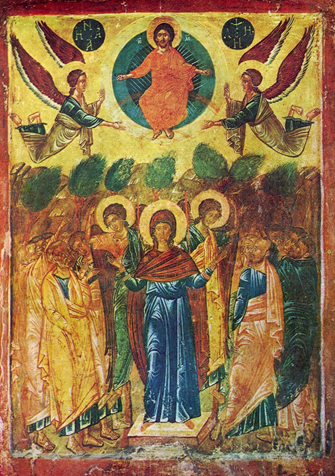
Sweet Jesus, while you lived on earth, You were God, inseparable from the Father, and yet a real Man.
Ascending in glory today from the Mount of Olives, through your great love You lifted up our fallen nature and placed it on God the Father’s throne.
Wherefore the hosts of bodiless heavenly beings were amazed and dazzled: silently fearful, they glorified your great love for mankind.
Together with them, we who live on earth glorify your coming down to us and your rising away from us, and implore you saying:
“Through your ascension, you have filled your apostles and your Mother with a joy that surpasses every other joy.
Through their intercession, make us worthy of the joy of your elect, for you are infinitely merciful.
*
(Hymn from the Byzantine rite at the Vespers of the feast of the Ascension of our Lord.
From the missal of the Greek Catholic Church of America, 1968)
Our responsibility
Man being the apex of Creation, he holds in some way, into his hands the world’s destiny. For that reason, when the first couple sinned and lost the presence and friendship of God, the whole creation was derailed, so to speak.
“The creation waits in eager expectation for the sons of God to be revealed” (Rom. 8, 19)
Christ, however, by His Passion and His Resurrection restored the fallen nature of man and reconciled him to God.
“Therefore, if anyone is in Christ, he is a new creation; the old has gone, the new has come” (2 Cor. 5, 17).
The new man, recreated through the sacrifice of the Son of God — and Son of Man, on the cross reflects the beauty and holiness of the Risen Lord; hence he is entrusted with a double mission: that is to try and remain in God’s grace, and to transmit this grace to the whole world.
This is the mission of the Body of Christ, i.e. His Church: to sanctify man and to preach the Good News of Salvation to the ends of the world!
It is certain that each one of us has got his part of responsibility in this amazing plan of love!
click here for Greek
 Open Reflections