πατήστε εδώ για Ελληνικά
THOUGH LOVING WE ARE WHERE CHRIST IS
Sometime before His Passion, our Lord Jesus prayed to His Father for the Apostles as well as for “all those who would believe in Him through their proclamation of the Good News”.
Jesus prays for us all!
What does he ask for us? To be always where He is and to have His love in us, so that we always remain united to Him and to each other (John 17).
But, how can we tell that we are where He is?
We only have to look around: we will see that Christ’s love has set the earth ablaze! It touches the hearts and spreads to all directions and all parts of our planet.
Christ’s presence among us, today, is the presence of His Church.
The love with which the Father loves the Son and those “He has given to Him” is a love that does not hesitate to reach down and protect the weak, the poor, the voiceless, those whom He calls to change their ways and turn towards the joy only God can give.
This love neither isolates the person who loves nor does it render him/her invulnerable to pain or even death.
This is a sacrificial love, a love fed on tears, fatigue, alertness, tenderness and care.
It brings with it the truth that hurts our selfishness, only because it strives to open our heart and mind to what lies ahead, further, higher.
This is love crucified; the love which brings life to the dead, sheds light in darkness, calls and saves the lost, brings hope to the desolate.
Authentic love cannot exist without the Cross and it always leads to the Resurrection.
Happy Easter!
Καλή Ανάσταση!
May the love you have for me be in them
Father, I want those you have given me to be with me where I am, and to see my glory you have given me because you loved me before the creation of the world.
Righteous Father, though the world does not know you, I know you and they know that you have sent me.
I have made you known to them, and will continue to make you known in order that the love you have for me may be in them and I myself may be in them.
John 17, 24-26.
Letter to Emperor Trajan
Meanwhile, in the case of those who were denounced to me as Christians, I have followed the following procedure: I interrogated them as to whether they were Christians; those who confessed I interrogated a second and a third time, threatening them with punishment; those who persisted I ordered executed. For I had no doubt that, whatever the nature of their creed, stubbornness and inflexible obstinacy surely deserve to be punished. There were others possessed of the same folly; but because they were Roman citizens, I signed an order for them to be transferred to Rome.
They asserted, however, that the sum and substance of their fault or error had been that they were accustomed to meet on a fixed day before dawn and sing responsively a hymn to Christ as to a god, and to bind themselves by oath, not to do some crime, but not to commit fraud, theft, or adultery, not falsify their trust, nor to refuse to return a trust when called upon to do so. When this was over, it was their custom to depart and to assemble again to partake of food — but ordinary and innocent food.
Even this, they affirmed, they had ceased to do after my edict by which, in accordance with your instructions, I had forbidden political associations. Accordingly, I judged it all the more necessary to find out what the truth was by torturing two female slaves who were called deaconesses. But I discovered nothing else but depraved, excessive superstition. I therefore postponed the investigation and hastened to consult you. For the matter seemed to me to warrant consulting you, especially because of the number involved. For many persons of every age, every rank, and also of both sexes are and will be endangered. For the contagion of this superstition has spread not only to the cities but also to the villages and farms. But it seems possible to check and cure it.
Pliny the Younger, Governor of Bithynia, Northern Asia Minor, from 111-113 A.D.
We have learned the truth
But we, after we have thus washed him who has been convinced and has assented to our teaching, bring him to the place where those who are called brethren are assembled, in order that we may offer hearty prayers in common for ourselves and for the baptized [illuminated] person, and for all others in every place, that we may be counted worthy, now that we have learned the truth, by our works also to be found good citizens and keepers of the commandments, so that we may be saved with an everlasting salvation.
Having ended the prayers, we salute one another with a kiss. There is then brought to the president of the brethren bread and a cup of wine mixed with water; and he taking them, gives praise and glory to the Father of the universe, through the name of the Son and of the Holy Ghost, and offers thanks at considerable length for our being counted worthy to receive these things at His hands.
And when he has concluded the prayers and thanksgivings, all the people present express their assent by saying Amen. This word Amen answers in the Hebrew language to ge’noito (γένοιτο), [so be it].
And when the president has given thanks, and all the people have expressed their assent, those who are called by us deacons give to each of those present to partake of the bread and wine mixed with water over which the thanksgiving was pronounced, and to those who are absent they carry away a portion.
(Saint Justin writing to Emperor Antoninus Pius about the Holy Mass; he was martyred in 150 A.D.
Did you know…
The English language has two words often used which, although interchangeable, have subtle differences in their meaning:
Gift and present.
At first sight one would think that they mean exactly the same thing.
However, if we examine their origin, we see that gift is derived from the verb to give, whereas present is relating to Latin and it may also mean “someone or something that is here”.
So, the language, which is the living vehicle of the collective thought and memory of the people, tells us that a present is something “more” than a gift, it is something that renders the giver present!
It unveils a “hidden” aspect of what is given to us: it is a token of the presence of the giver.
We could rightly say that the giver is always present in his/her gift!
How rich are the connotations of this simple little word “present” and how much can it embellish our experience!
What is truth?
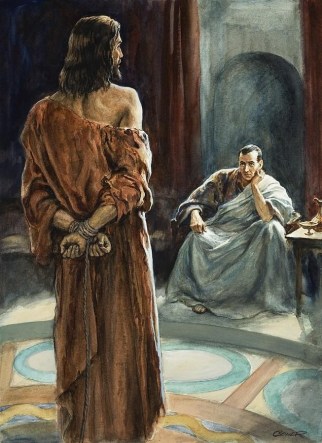 Pilate asks the eternal question: “what is truth?” remaining, however, blind to the Truth facing him.
The Roman governor cannot recognize the truth in the person of Jesus, who is calmly standing before him, bound and falsely accused by people whose only aim has been their narrow interest of power and comfort as well as their venting out their frustration at their crumbling world.
The crowd, eager to please the ruling class of the Priests, the Pharisees and the Scribes they turn to the occupying authorities with the demand to crucify Jesus.
The itinerant teacher made them uneasy, uncomfortable: they refused to look into themselves, into their own conscience, to face their own sin and their own reality. They stifled the truth in their minds and hearts and so were capable of the worst crime in history, the crucifixion of the All Innocent, the Son of God, who became the Son of Man and lived, worked, taught, healed and accepted death out of love!
But the Truth sets us free and Truth saves, for Jesus came to give His life as a ransom for many (Mt. 20, 28, Mk. 10,45, John 13, 1-17), and through his sacrifice to offer us Life, life in abundance! (John 10, 10).
Out of the depths

Out of the depths I cry to you, O Lord; O Lord, hear m let your ears be attentive to my cry for mercy.
If you, O Lord, keep a record of sins, O Lord, who could stand? But with you there is forgiveness; therefore you are feared.
I wait for the Lord, my soul waits, and in his word I put my hope.
My soul waits for the Lord more than watchmen wait for the morning, more than watchmen wait for the morning.
O Israel, put your hope in the Lord, for with the Lord is unfailing love
and with him is full redemption.
He himself will redeem Israel from all their sins.
(Psalm 130)
The Resurrection
We know that Christ’s sacrificial death has opened the way of our reconciliation with God.
This knowledge is not theoretical: it animates the Church, and through her the whole human history for well over two thousand years!
The Church unceasingly proclaims the Good News of Christ’s Resurrection!
As Saint Paul insists: “If Christ has not been raised from the dead, our preaching is useless and so is our faith!” (1 Cor. 15, 14).
Indeed, how would Jesus’ death transcend the earthly horizons, and what would be the meaning of the death of all the martyrs throughout the centuries?
The history of the Church would make no sense and what credibility would her message have if she did not proclaim what really happened, i.e. the death and the resurrection of the Incarnate Son of God?
The Resurrection of the Lord is the sign that His sacrificial death has been accepted on our behalf by God the Father.
Jesus by His total offering of His life can call us now to be “where He is”; we can now love with His love, see the world lovingly with Him, act in various situations as He would act and hope to be eternally with Him “to see His glory”.
What immeasurable love!
click here for English
 Open Reflections
One thought on “Love sets the earth ablaze”