πατήστε εδώ για Ελληνικά
Expectancy and recognition
The epitome of the Christmas season is the feast of the Presentation of the Lord, which “seals”, so to speak, the first days of the coming and the manifestation of the Son of God into the world.
Son of God, but also Son of Mary, Jesus meets His people. He meets them where their worship to the One and Unique God is publicly (and according to the Law) expressed: i.e. at the Temple of Solomon in Jerusalem.
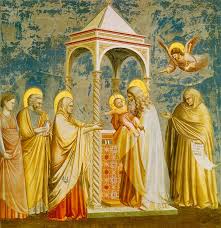 The persons who meet Him –and who recognize Him, represent all the best this people has to offer: “They were faithful and pious, and expected with living faith and hope Israel’s salvation”, therefore, “the Holy Spirit guided them” (Lk. 2, 25). Both, old Symeon and the prophetess Anna saw and recognized in the person of Baby Jesus the fulfillment of God’s promises.
From time immemorial, since the fall of the first couple, since the first murder committed against Abel by his brother Cain, humanity goes laboriously on her way seeking constantly her liberation from the evils she herself causes.
God’s words to Cain loudly resonate to the ends of the earth until this world gives way to the “new heaven and new earth” in “the glory of the children of God” (1 John 2, 29, Rom. 8, 18-21).
“Where is your brother?”
Yes, all of us, without exception, are our brothers’ and sisters’ keepers!
If we do what is right we will have absolutely no reason to be downcast and despondent.
God’s voice is within us; it is called our Christian conscience. And we must needs pay heed to it!
For, in this way we will be able to carry on as the Heavenly Father’s sons and daughters.
If you do what is right…
The Lord looked with favour to Abel and his offering, but on Cain and his offering he did not look with favour. So Cain was very angry, and his face was downcast.
Then the Lord said to Cain: “Why are you angry? Why is your face downcast? If you do what is right, will you not be accepted? But if you do not do what is right, sin is crouching at your door; it desires to have you, but you must master it”.
Now Cain said to his brother Abel“, Let‘s go to the field.”. And while they were in the field, Cain attacked his brother Abel and killed him.
Then the Lord said to Cain, “Where is your brother Abel?” I don’t know,” he replied. “Am I my brother’s keeper?” . (Genesis 4, 4-9)
The common good
There is but one mission of the Church and every baptized Christian has a vital part in this mission.
That mission is to evangelize and proclaim the Gospel, “to ensure that God’s grace may touch the heart of every man and of every woman and lead them to him.”
Furthermore, for every Christian, for the whole Church, mission is not optional, but an essential part of his identity.
The more we strive to secure a common good corresponding to the real needs of our neighbours, the more effectively we love them.
Man’s earthly activity, when inspired and sustained by charity, contributes to the building of the universal city of God, which is the goal of the history of the human family.
In an increasingly globalized society, the common good and the effort to obtain it cannot fail to assume the dimensions of the whole human family, that is to say, the community of peoples and nations.
Thus we strive to shape the earthly city in unity and peace, anticipating to some degree the undivided city of God.
The secret
 Glancing through the Church calendar we notice that on every day there is commemoration of saints, who either by their martyrdom or their heroic Christian life have given witness to their faith in Christ and His Church.
So, what was their secret? How were they able to ignore troubles and tribulations, even untimely violent death?
How did they give their life to the service of the poor and the sick/? How did they traverse the earth and sailed the seas in order to bring the Gospel where it was not yet known? To baptize, to teach, to become the voice of the weak?
And, what about ourselves? What can we do?
We, also, can devote our life to our neighbours service: the mother who stays awake by her sick child, the nurse who looks after the comfort of the patient, the teacher who passionately imparts his knowledge, the scientist who studies new technologies, the writer who has something positive to share, the conscientious worker…the list is infinite.
Is it the same? What is the difference?
If everything we do we do it out of love of God and neighbour, if our inspiration are the promptings of the Holy Spirit, then, yes, we have discovered the secret power of the Saints! Saints are all those who have trustingly obeyed God’s calling not knowing in advance where it might lead them!
The wind blows wherever it pleases, you hear its sound, but you cannot tell where it comes from or where it is going. So it is with every one born of the Spirit (John 3, 8).
Did you know…
The Slavic peoples owe their alphabet to the two brothers Saints Cyril and Methodius.
They were Greek from Thessaloniki, who set off to evangelize the people on the banks of the Danube river and at the Black Sea, during the second half of the 9th century.
Cyril was a deacon and Methodius was ordained priest; in later years Methodius was made Archbishop of Great Moravia, Pannonia and Serbia by the Pope.
They invented the alphabet —known nowadays as Cyrillic, adapted to the particular sounds of the Slavic linguistic idioms, in order to write the Gospel and the Bible and other works in their language.
Russia, Bulgaria, Serbia —to name but a few, are countries that even today use the Cyrillic alphabet.
For their mission and work among the Slavs the Church recognizes them as Apostles of the Slavic peoples and honours their memory on Feb. 14th in the Western Church and on various dates, depending on the country, in the Eastern Church.
On conscience
The term conscience, according to Saint Paul, corresponds to the Biblical notion of heart.
Writes the Apostle: “I urge…certain men not to teach false doctrines any longer….These promote controversies rather than God’s work—which is by faith. The goal of this command is love, which comes from a pure heart and a good conscience and a sincere faith” (1Tit. 1, 5)
Jesus condemns the Pharisees who defend the righteousness of their own conscience through their materialistic application of the Law.
Christ does not abolish the Law, but He shows us that a pure intention must direct its application.
The Lord liberates the conscience teaching us to judge according to the heart, through healthy eyes, in the presence of the Heavenly Father who sees “what is done in secret” (Mt. 15, Lk. 11, 34, Mt. 6 et al.)
Thus Jesus prepares the emergence of a free conscience, when the Law will not any longer be external to man, but it will find its true meaning and strength, through the Holy Spirit who inundates the hearts.
Inter connectivity
In the story of Cain and Abel, we see how envy led Cain to commit the ultimate injustice against his brother, which in turn ruptured the relationship between Cain and God, and between Cain and the earth from which he was banished.
This is seen clearly in the dramatic exchange between God and Cain. God asks: “Where is Abel your brother?” Cain answers that he does not know, and God persists: “What have you done? The voice of your brother’s blood is crying to me from the ground. And now you are cursed from the ground” (Gen 4:9-11).
Disregard for the duty to cultivate and maintain a proper relationship with my neighbour, for whose care and custody I am responsible, ruins my relationship with my own self, with others, with God and with the earth. When all these relationships are neglected, when justice no longer dwells in the land, the Bible tells us that life itself is endangered.
We see this in the story of Noah, where God threatens to do away with humanity because of its constant failure to fulfill the requirements of justice and peace: “I have determined to make an end of all flesh; for the earth is filled with violence through them” (Gen 6:13).
These ancient stories, full of symbolism, bear witness to a conviction which we today share, that everything is interconnected, and that genuine care for our own lives and our relationships with nature is inseparable from fraternity, justice and faithfulness to others.
Pope Francis, Encyclical Laudato Si’, § 70
When love beckons to you
When love beckons to you, follow him,
Though his ways are hard and steep.
And when his wings enfold you yield to him,
Though the sword hidden among his pinions may wound you.
And when he speaks to you believe in him,
Though his voice may shatter your dreams
as the north wind lays waste the garden.
For even as love crowns you so shall he crucify you. Even as he is for your growth so is he for your pruning.
Even as he ascends to your height and caresses your tenderest branches that quiver in the sun,
So shall he descend to your roots and shake them in their clinging to the earth.
Like sheaves of corn he gathers you unto himself.
He threshes you to make you naked.
He sifts you to free you from your husks.
He grinds you to whiteness.
He kneads you until you are pliant;
And then he assigns you to his sacred fire, that you may become sacred bread for God’s sacred feast.
All these things shall love do unto you that you may know the secrets of your heart, and in that knowledge become a fragment of Life’s heart.
But if in your fear you would seek only love’s peace and love’s pleasure,
Then it is better for you that you cover your nakedness and pass out of love’s threshing-floor,
Into the seasonless world where you shall laugh, but not all of your laughter, and weep, but not all of your tears.
Love gives naught but itself and takes naught but from itself.
Love possesses not nor would it be possessed;
For love is sufficient unto love.
When you love you should not say, “God is in my heart,” but rather, “I am in the heart of God.”
And think not you can direct the course of love, for love, if it finds you worthy, directs your course.
Love has no other desire but to fulfill itself.
But if you love and must needs have desires, let these be your desires:
To melt and be like a running brook that sings its melody to the night.
To know the pain of too much tenderness.
To be wounded by your own understanding of love;
And to bleed willingly and joyfully.
To wake at dawn with a winged heart and give thanks for another day of loving;
To rest at the noon hour and meditate love’s ecstasy;
To return home at eventide with gratitude;
And then to sleep with a prayer for the beloved in your heart and a song of praise upon your lips.
Khalil Gibran, 1883-1931
click here for Greek
 Open Reflections
One thought on “What is right”