
Informative bulletin of the Paphos Latin Parish
November 2018
για Ελληνικά πατήστε εδώ
A life’s journey
The “door of faith” (Acts 14:27) is always open for us, ushering us into the life of communion with God and offering entry into his Church. It is possible to cross that threshold when the word of God is proclaimed and the heart allows itself to be shaped by transforming grace. To enter through that door is to set out on a journey that lasts a lifetime.
The Father, in the fullness of time sent his Son for our salvation; Jesus Christ, who in the mystery of his death and resurrection redeemed the world; the Holy Spirit, leads the Church across the centuries as we await the Lord’s glorious return.
The renewal of the Church is also achieved through the witness offered by the lives of believers: by their very existence in the world, Christians are called to radiate the word of truth that the Lord Jesus has left us.
The Church, ‘like a stranger in a foreign land, presses forward amid the persecutions of the world and the consolations of God’, announcing the cross and death of the Lord until he comes (1 Cor 11:26).
But by the power of the risen Lord it is given strength to overcome, in patience and in love, its sorrow and its difficulties, both those that are from within and those that are from without, so that it may reveal in the world, faithfully, although with shadows, the mystery of its Lord until, in the end, it shall be manifested in full light.
Only through believing, then, does faith grow and become stronger; there is no other possibility for possessing certitude with regard to one’s life apart from self-abandonment, in a continuous crescendo, into the hands of a love that seems to grow constantly because it has its origin in God.
(Benedict XVI, Oct. 2011)
A cloud of witness
The witnesses who have preceded us into the kingdom, especially those whom the Church recognizes as saints, share in the living tradition of prayer by the example of their lives, the transmission of their writings, and their prayer today. They contemplate God, praise him and constantly care for those whom they have left on earth. When they entered into the joy of their Master, they were “put in charge of many things. Their intercession is their most exalted service to God’s plan. We can and should ask them to intercede for us and for the whole world.
Catechism of the Catholic Church, §2683
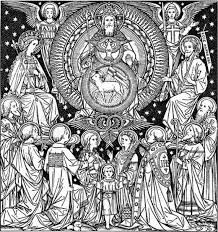
Mother Church honours her children…
All Saints Day is a surprisingly old feast. It arose out of the Christian tradition of celebrating the martyrdom of saints on the anniversary of their martyrdom. When martyrdoms increased during the persecutions of the late Roman Empire, local dioceses instituted a common feast day in order to ensure that all martyrs, known and unknown, were properly honored.
By the late fourth century, this common feast was celebrated in Antioch, and Saint Ephraim the Syrian mentioned it in a sermon in 373.
In the early centuries, this feast was celebrated in the Easter season, and the Eastern Churches, both Catholic, and Orthodox, still celebrate it then, tying the celebration of the lives of the saints in with Christ’s Resurrection.
Why November 1?
The current date of November 1 was instituted by Pope Gregory III (731-741), when he consecrated a chapel to all the martyrs in Saint Peter’s Basilica in Rome.
Gregory ordered his priests to celebrate the Feast of All Saints annually. This celebration was originally confined to the diocese of Rome, but Pope Gregory IV (827-844) extended the feast to the entire Church and ordered it to be celebrated on November 1.
…and prays for them
In English, the traditional name for All Saints Day was All Hallows Day. (A hallow was a saint or holy person.) The vigil or eve of the feast, October 31, is still commonly known as All Hallows Eve, or Halloween. Despite concerns among some Christians (including some Catholics) in recent years about the “pagan origins” of Halloween the vigil was celebrated from the beginning—long before Irish practices, stripped of their pagan origins (just as the Christmas tree was stripped of similar connotations), were incorporated into popular celebrations of the feast.
In fact, in post-Reformation England, the celebration of Halloween and All Saints Day were outlawed not because they were considered pagan but because they were Catholic. Later, in the Puritan areas of the Northeastern United States, Halloween was outlawed for the same reason, before Irish Catholic immigrants revived the practice as a way of celebrating the vigil of All Saints Day (see bulletin of Nov. 2016).
All Saints Day is followed by All Souls Day (November 2), the day on which the Church commemorates all those Holy Souls who have died and are in Purgatory, being cleansed of their sins so that they can enter into the presence of God in Heaven.
Did you know…
The word holy, which is used to describe God, but also his angels and his people, is the translation of the Semitic word qodesh which comes from a root that means cut off, separate.
The holy things are the things that are cut off from the world and which no one may touch (except through a strict purifying ritual).
The Biblical sense of holiness is much richer. It is not enough to prescribe man’s attitude in front of holiness, but it includes the revelation of God himself!
God is the source of every holiness. The problem of the nature of holiness is the problem of the mystery of God and his communication with mankind.
Initially external as regards persons, sites and objects that are sacred, holiness becomes real and inner through the gift of the Holy Spirit.
Sin prevents holiness to shine forth, but Love, which is God himself, overcomes sin and prevails, thus sanctifying his Church and leading her to the splendour of holiness and glory.
A world of peace?
Pope Leo I the Great (440-461) served at the helm of the Church in many great ways.
Not only he wrote important theological works and effectively contributed at the Fourth Ecumenical Council in Chalcedon (451) which he convoked, but he, also, had to confront external enemies of the Faith and civilization.
In 452 Attila, “the scourge of God” was threatening to sack the Eternal City.
Pope Leo chose to personally meet the Hun. So in 452 AD the two men met in the middle of the river Mincio near Mantua, on horseback.
No one knows what was said between the two men. Attila, however, did not advance towards Rome. On the contrary he withdrew for good at the regions above the river Danube!
We cannot overstate the importance of this event!
Europe and her Christian population were saved from a grave danger!
*
There are always external enemies to confront; we must defend the Christian character of our civilization. To this end we need holy pastors and holy men and women and children in every walk of life!
Only the saints, i.e. they who are wholly dedicated to the Gospel’s realization, are in a position to transform our world into a world of solidarity, peace and love.
The righteous rejoice before God

May God arise, may his enemies be scattered; may his foes flee before him.
May you blow them away like smoke—as wax melts before the fire, may the wicked perish before God.
But may the righteous be glad and rejoice before God; may they be happy and joyful.
Sing to God, sing in praise of his name, and extol him who rides on the clouds; rejoice before him—
His name is the Lord.
Your people settled in it, and from your bounty, God, you provided for the poor.
Our God is a God who saves; from the Sovereign Lord comes escape from death.
Sing to God, you kingdoms of the earth, sing praise to the Lord, to him who rides across the highest heavens.
You, God, are wonderful in your saints;
The God of Israel gives power and strength to his people.
Praise be to God!
(Psalm 67, excerpts)
Christ the King
Father, all-powerful and ever-living God, we do well always and everywhere to give you thanks.
You anointed Jesus Christ, your only Son, with the oil of gladness as the eternal priest and universal king.
As priest he offered his life on the cross and redeemed the human race by this one perfect sacrifice of peace.
As king he claims dominion over all creation that he may present to you, his almighty Father, an eternal and universal kingdom: a kingdom of truth and life, a kingdom of holiness and grace, a kingdom of justice, love and peace.
And so, with all the choirs of angels in heaven we proclaim your glory and join in their unending hymn of praise:
Holy, holy, holy Lord God of hosts.
Heaven and earth are full of your glory.
Hosanna in the highest.
Blessed is he who comes in the name of the Lord.
Hosanna in the highest.
(Preface of the feast of Christ the King, year B)
click here for Greek
 Open Reflections
One thought on “The power of holiness”