για Ελληνικά πατήστε εδώ
A popular prayer
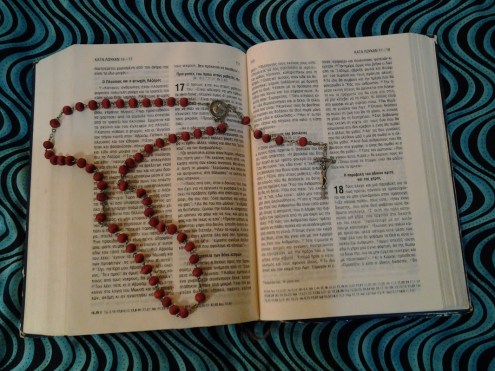
The Rosary -the word denotes a garland of roses, has a long tradition in the spiritual life of the Church and it is connected to Saint Dominic who lived at the end of the 12th and the beginning of the 13th century.
The Rosary is a prayer which wholly draws its inspiration from the Word of God, i.e. the Holy Scriptures.
It proposes as a model the Virgin Mary, the woman whom God chose to become His Mother and who knew how to positively respond to this calling.
Focusing our attention to the principal events in the life of Jesus Christ and the Virgin, the Rosary makes us familiar with the Mystery of God’s presence in the world as well as in our own personal history.
Traditionally, the Rosary contains 15 “Mysteries”, that is events from the lives of Jesus and Mary and which we distinguish in “joyful”, “sorrowful’ and “glorious”.
In 2002 Saint Pope John-Paul II proposed the addition of another five, namely the “luminous” Mysteries. These are: the Lord’s Baptism, the Wedding at Cana, the Proclamation of the Gospel, the Transfiguration of the Lord and the Last Supper.
For every faithful the prayer of the Rosary can be three things at the same time: prayer, meditation and spiritual study –given it enough time.
The month of the Rosary

During the whole month of October we pray the holy Rosary in union with the Virgin Mary and for the intentions of the Holy Father.
We meditate one-by-one the Mysteries of our Faith: the “joyful”, the “luminous”, the “sorrowful” and the “glorious”.
The holy Rosary is a very simple, deep and easily accessible to all prayer.
It has awoken and reinforced numerous priestly and religious vocations and kept many a family united and strong in their Christian life and continues to do so.
Continuous prayer
If we deem it difficult and nigh impossible for anyone to be able to continually pray, then we shall be surprised by Saint Paul’s admonition: “pray unceasingly!” (1 Thess. 5, 17).
There is a particular and set way for the public prayer of the People of God in their ecclesiastical gatherings; this is the liturgical prayer of the Church; but there is also the private, personal prayer of each one of us.
These two ways of prayer have one important thing in common: they are communication and offering. Communication with the Triune God and offering of oneself to Him. the latter is not always obvious, nevertheless it remains a fact!
The person who gets in dialogue with his Saviour sets before Him himself with all his preoccupations and all his hopes, his pain and joy, his success and failure, his desires and his sin. This presentation is his offering.
In the liturgical prayer, though, Christ Himself is offered! He is offered in our place (atonement) for our salvation.
So, even if we cannot pray continually, we know that the Church, as the Body of Christ, unceasingly prays for all and in every corner of the earth!
In truth, nobody who prays is ever alone: he is existentially and mystically united to the praying Church on earth and in Heaven in her unceasing praise to God!
In brief

The ecclesiastical communion is the fulfillment of the divine plan in Christ Jesus “who came not only for that nation but also for the scattered children of God, to bring them together and make them one” (John 11, 52).
It is the sign of the mysterious presence of God, for, before he became manifest in the Bread and Wine, Jesus becomes manifest through the Christians “who are one body”.
It also is the realization of Pentecost which is going on by the power of the Holy Spirit. Paul’s prompting perfectly expresses the above: “Accept one another, then, just as Christ accepted you, in order to bring praise to God“. (Rom. 15, 7).
Did you know…
The liturgical word alleluia has its origin in the Hebrew word hillaal.
It comes from the Semitic etymological root h l l.
Grammatically, it is the imperative (masculine plural (h) allelu (=give praise) ia (to ia/ya)/
Ia /Ya is short for Yahwe, the name of God in the Bible.
Therefore, alleluia means give praise to God.
הללויה
Yahwe although is a name (the name of God), it is in the form of a verb and it means he who is, he who exists, he who lives.
In the Church’s liturgical usage, alleluia adds an extra dimension of triumph and joy; the joy on the part of God’s People for His loving Presence among them.
Changes

Autumn’s arrival with the foliage which changes to warmer colours and the leaves that swirl and dance in the breeze as they begin to scatter and cover like a thick carpet the earth sets us to a meditative and reflective mood.
Our life seems to be built upon changes!
It is fortunate that change exists! Nothing remains static; nothing stays monotonous.
Sooner-or-later we too adjust to the seasonal rhythm which contains deep in itself the certainty that “all is well” (Gen.1)
Becoming aware of the harmony that surrounds us is a cause of deep joy and emotion.
This natural harmony is a portent of a certainty and a promise: the certainty of belonging to something vaster and more beautiful; the promise of our intimate hopes becoming true and the promise of a Love which is a Presence.
All is grace, all is a gift from God.
How do we respond to Him?
The Angelic Greeting

Hail Mary,
Full of grace,
The Lord is with thee.
Blessed art thou amongst women
And blessed is the fruit of thy womb, Jesus
Holy Mary,
Mother of God,
Pray for us now
And at the hour of our death.
Amen.
Two exceptions
Traditionally, the feast of a saint is held on “dies natalis,” which is the day of one’s death or their “birth in heaven.”
John Paul II died on April 2 but that day usually falls during Holy Week. To guarantee the day will be solemnly celebrated every year, the Vatican has decided his day of liturgical memory will be on October 22, the Anniversary day of the Mass for the inauguration of his pontificate in 1978.
Likewise, the feast day of Pope John XXIII is not set on his “dies natalis”, i.e. on 3rd June (he left this world on 3/6/1963). Instead his memory is celebrated on 11th October.
That particular day is the anniversary of the inauguration of the works of the Second Vatican Council (22nd Ecumenical) in 1962.
It was John XXIII who summoned all the Bishops of the world and convened the Holy Synod.
Vatican II, as the Synod is widely known, has been an amazing work of the Spirit guiding His Church in the modern world.
click here for Greek
 Open Reflections
One thought on “Pray always”