για Ελληνικά πατήστε εδώ
Informative Bulletin of the Paphos Latin Parish
September 2018
Be always prepared
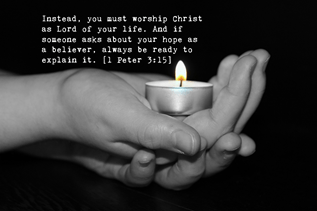
Honour the Lord with all your heart. Always be prepared to give an answer to everyone who asks you to give the reason for the hope that you have. (! Pet. 3, 15).
Saint Peter insists we must know in what and why we believe, in order to be in a position, we too, to evangelize those who seek hope and salvation.
Since, however, we can give only that which we possess, it is an absolute necessity to know well and in depth the Faith of the Church.
The Church, as the Body of Christ, possesses the truth and transmits it to us. The Holy Scriptures are the God-inspired texts which make the stem, so to speak, of the faith and doctrine of the Church.
The Old Testament traverses the times before the Incarnation of the Son of God and shows us the slow but steady preparation of humanity for the Saviour’s coming.
The New Testament reveals to us the person and work of Christ and the founding of the Church.
The two parts of the Bible, i.e. the Old and the New Testaments, are inseparable “pieces” of the one and only whole.
All the books of the Bible are full of the Word of God who addresses every man.
Its message is a message of love that reaches its peak and is fully revealed to us through the Incarnation of the Lord, his sacrificial death on the Cross and his Resurrection.
Let there be no hesitation in opening the Holy Scriptures and read them.
The Holy Spirit since the day of Pentecost, when He established the Church, has never abandoned her! He is always present, sanctifying and guiding her.
Let us, with courage and boldness, ask Him to enlighten our minds and warm up our hearts.
A great precipice and gulch
A great precipice and gulch is the ignorance of the Scriptures, and not to know the divine laws is a treason regarding our salvation.
This is what Saint John Chrysostom (4th c.) says, emphasizing the importance of the knowledge of the Holy Scriptures for all believers.. Without the light of Faith and the support of the Tradition we have no strength to resist and surpass the problems and temptations life throws at us.
The Church gives us the Faith, that “space’ of the living Apostolic Tradition, and the only authority for the interpretation of the Scriptures.
Let us, therefore, listen carefully to the teachings of Mother Church.
 The experience of God’s revelation
The Bible, i.e. the Holy Scriptures, is not the product of one author or one era, but it comprises of texts which cover a centuries long period in time, and in which reflect the linguistic idioms and the means of expression of each era, its philosophical, theological and religious ideas and concepts as well as the political and social conditions at each time.
The Bible, however, is not only man’s work, but also divine; it is not the product of a desk, the fruit of the theoretical wanderings of an intellectual or the making of some priesthood; behind each biblical text there is God’s revelation to His People, who lived and kept alive in their tradition their experience.
It is exactly this experience of God’s revelation in the midst of human history the common element that holds together this collection of multiform texts in a unified body and gives it its wonderful unity, from its very first book to its very last one.
(From the introduction to the book of the Holy Bible, Greek Edition of the Biblical Society, Athens 1997)
The living Tradition


The Spirit of the Risen Christ remains with his own in order to teach them all things and to lead them in the whole truth (John 14, 26 and 16, 13).
There is, therefore no difference between the authority of the Apostles and the authority of their teacher: “”He who listens to you listens to me; he who rejects you rejects me; but he who rejects me rejects him who sent me” (Lk. 10, 16)
So, the Apostolic Tradition enjoys a unique authority which, at the same time, covers the Scriptures, where it became clear.
The tradition of the apostolic times was the “space” where the Apostles clarified the meaning and importance of Jesus’s words and deeds.
The later ecclesiastical tradition simply keeps the Apostolic tradition.
Only the living Tradition has something that the Scriptures cannot give us: the deep understanding of the inspired texts; this understanding is the work of the Spirit who acts within the Church.
Thanks to Him the Word that got consolidated in the Scriptures always remains the living Word of our Lord Jesus Christ.
(Dictionary of Biblical Theology, Editions of Cerf, Paris 1971, Athens 1980, page 767)
Did you know…
 The Greek word βιβλίο (=book) comes from the name of the Phoenician city of Byblos, the Zbail of nowadays Lebanon.
In classic antiquity from there the processed papyrus was imported to the great cities of the then known world.
The name Byblos (hence Bible=Book) is thought to be of Semitic origin, perhaps from the Hebrew word Gébãl, which means region, border.
According to other experts the word is from the Greek root βι– , (vi-) hence βί-ος (=life).
Βί-η + βλαστός (life = strong bark, i.e. the inner bark of the papyrus plant)) gave the word Byblos.
Whichever the case may be a book is always a window to the world.
The Holy Bible, however, is a “window” to God’s grace and intimacy.
A seal of the Spirit
Parrhesía (boldness) is a seal of the Spirit; it testifies to the authenticity of our preaching. It is a joyful assurance that leads us to glory in the Gospel we proclaim. It is an unshakeable trust in the faithful Witness who gives us the certainty that nothing can “separate us from the love of God” (Rom 8:39).
We need the Spirit’s prompting, lest we be paralyzed by fear and excessive caution, lest we grow used to keeping within safe bounds.
Let us remember that closed spaces grow musty and unhealthy.
When the Apostles were tempted to let themselves be crippled by danger and threats, they joined in prayer to implore parrhesía (bold-ness): “And now, Lord, look upon their threats, and grant to your servants to speak your word with all boldness” (Acts 4:29). As a result, “when they had prayed, the place in which they were gathered together was shaken; and they were all filled with the Holy Spirit and spoke the word of God with boldness” (Acts 4:31).
God is eternal newness. He impels us constantly to set out anew, to pass beyond what is familiar, to the fringes and beyond.
He takes us to where humanity is most wounded, where men and women, beneath the appearance of a shallow conformity, continue to seek an answer to the question of life’s meaning
(Apostolic Exhortation Gaudete et Exsultate of the Holy Father Francis on the call to holiness in today’s world, §132, 133 and 135).
To Autumn
Season of mists and mellow fruitfulness, Close bosom-friend of the maturing sun; Conspiring with him how to load and bless With fruit the vines that round the thatch-eves run; To bend with apples the moss’d cottage-trees, And fill all fruit with ripeness to the core; To swell the gourd, and plump the hazel shells With a sweet kernel; to set budding more, And still more, later flowers for the bees, Until they think warm days will never cease, For summer has o’er-brimm’d their clammy cells.
Who hath not seen thee oft amid thy store? Sometimes whoever seeks abroad may find Thee sitting careless on a granary floor, Thy hair soft-lifted by the winnowing wind; Or on a half-reap’d furrow sound asleep, Drowsed with the fume of poppies, while thy hook Spares the next swath and all its twined flowers: And sometimes like a gleaner thou dost keep Steady thy laden head across a brook; Or by a cider-press, with patient look, Thou watchest the last oozings, hours by hours.
Where are the songs of Spring? Ay, where are they? Think not of them, thou hast thy music too,– While barred clouds bloom the soft-dying day, And touch the stubble-plains with rosy hue; Then in a wailful choir the small gnats mourn Among the river sallows, borne aloft Or sinking as the light wind lives or dies; And full-grown lambs loud bleat from hilly bourn; Hedge-crickets sing; and now with treble soft The redbreast whistles from a garden-croft, And gathering swallows twitter in the skies
John Keats, 1795 – 1821
click here for Greek
 Open Reflections
One thought on “Honour the Lord”