για Ελληνικά πατήστε εδώ
INFORMATIVE BULLETIN OF THE PAPHOS LATIN PARISH
July 2018
…never forgotten
It is said that “God’s colours never fade”! The meaning of this saying is quite profound despite its simplicity. God’s works, the beauty of His creation and His grace are His gifts to us, gifts which He never takes back.
God in His love, accompanies man and never ceases to shower him with blessings.
From the beginning and throughout the times of the Patriarchs and the Prophets God’s promises formed man’s hope.
Christ’s coming was the fulfilment of those promises, and the Church is now the “space” where man receives the eternal promises and gifts: forgiveness of sins, reconciliation, peace, fortitude, joy.
The list is not exhaustive.
The world is perplexed by the Christian way of life.
The joy of the saints, even in the midst of tribulations and suffering, is a constant challenge and a paradox.
But, the saints have discovered God’s secret, namely His beauty. He is Perfection par excellence. He is Love, He is Saviour, He is our Father, He is the source of our spiritual life, therefore He is Joy and He is our joy!
Once we have experienced His proximity and overwhelming love we cannot forget the suavity and beauty of the encounter.
It is like His love is engraved with the most vivid and beautiful colours into our souls.
The encounter with the Lord lends colour to all we do and think and aspire to.
With Christ we see all things at their right place and become capable of discerning what is good and noble and loveable and just, as Saint Paul emphasizes in his letter to the church in Philippi (nowadays Kavala in Northern Greece).
REJOICE!
Rejoice in the Lord always. I will say it again: Rejoice! Let your gentleness be evident to all. The Lord is near. Do not be anxious about anything, but in every situation, by prayer and petition, with thanksgiving, present your requests to God. And the peace of God, which transcends all understanding, will guard your hearts and your minds in Christ Jesus.
Finally, brothers and sisters, whatever true, whatever is noble, whatever is right, whatever is pure, whatever is lovely, whatever is admirable—if anything is excellent or praiseworthy—think about such things. Whatever you have learned or received or heard from me, or seen in me—put it into practice. And the God of peace will be with you.
(Phil. 4, 2-9)
BEAUTY IS TRUTH
“Beauty is truth, truth beauty,– that is all
Ye know on earth, and all ye need to know.”
Famous lines from J. Keats’ poem, “Ode on a Grecian Urn”.
The quest for truth and the admiration of beauty seem to be naturally following each other; they seem to delineate man’s most noble preoccupations in his search for meaning and mission.
Every artist who places himself via-à-vis an encounter with the infinite, who labours in harmony with his heart, mind and hands, is almost as if he is performing a religious act of reverence to God who created this beautiful world and who placed us, men and women, in it with the capacity to appreciate its beauty.
Our Christian tradition, in both East and West, bespeak of God’s beauty and truth. Our cathedrals, our humble chapels, our hymns, our iconography and education, our plastic arts, even our legal system have roots which run deep into the fertile soil of Church and Christianity.
We must safeguard this heritage, rich with the blood of martyrs and the countless efforts and struggles of innumerable generations of the faithful, who strove –and keep striving, for sanctity for themselves and for the world.
“You are the most handsome of the sons of men; grace is poured upon your lips; therefore God has blessed you forever” sings the psalmist (Ps. 45, 2) in this way foretelling the coming and mission of our Lord Jesus Christ.
It is only in Him that we can meet the fullness of truth and beauty.
SPACE TO FEEL
One of the attractions of poetry is that it gives one space to freely move and feel.
The best poetry is that which reflects our inmost yearnings.
Poetry may be consider the “voice of the soul”, whispering, meditating, celebrating, praising and singing.
Since poetry wells up from our deepest thoughts and feelings it serves its purpose in the same way across nations and through time.
Created in the image of God, all people can “meet” by the means of poetry.
Even in remote cultures the poet discovers the transcendent, i.e. God’s presence: “When you do things from your heart, you feel a river moving in you, a joy”, wrote the famous Persian poet Rumi (1207-1273).
*
Certainly, every artist, no matter in which field he/she works, in their efforts to be inwardly and outwardly attuned to nature’s beauty, they become increasingly more sensitive to the divine presence, which is the beauty par excellence
DID YOU KNOW…
 The word Harmony is first attested in English usage in 1602.
It comes originally from the Greek word ἁρμονία (harmonía, “joint, union, agreement, concord of sounds”).
It is present in all European languages, e.g. harmonie in French, harmony in English, armonίa in Spanish and so on.
Its original meaning was that of “fitting well together”, “be in equilibrium of proportions”, “be pleasing to the eye, or ear”, “be orderly and good”.
*
The din of disharmony which is present in the world is a direct consequence of the disequilibrium in the relationship of man with his Creator.
Christ has brought, through His Cross and Resurrection, the reconciliation and the forgiveness of sins.
The mission of the Church is to re-establish and facilitate a good and harmonious relationship of all peoples to God and amongst themselves.
A RADIANT EXPRESSION

The beauty of sacred art is always a fruit of a deeper knowledge and love of God in Jesus Christ, the only-begotten Son of God, Who is all beautiful.
The liturgy is a radiant expression of the paschal mystery, in which Christ draws us to himself and calls us to communion and like all Christian Revelation it is inherently linked to beauty: it is the splendour of truth.
In Jesus we contemplate beauty and splendour at their source”.
The truest beauty is the love of God, who definitively revealed himself to us in the paschal mystery.
The beauty of the liturgy is part of this mystery; it is a sublime expression of God’s glory and, in a certain sense, a glimpse of heaven on earth. The memorial of Jesus’ redemptive sacrifice contains something of that beauty which Peter, James and John beheld when the Master, making his way to Jerusalem, was transfigured before their eyes (Mk 9:2).
Beauty, then, is not mere decoration, but rather an essential element of the liturgical action, since it is an attribute of God himself and his revelation.
The liturgy should be beautiful because it reflects on earth and praises God’s infinite beauty in heaven.
(Pope Benedict XVI)
A THING OF BEAUTY
A thing of beauty is a joy for ever:
Its lovliness increases; it will never
Pass into nothingness; but still will keep
A bower quiet for us, and a sleep
Full of sweet dreams, and health, and quiet breathing.
Therefore, on every morrow, are we wreathing
A flowery band to bind us to the earth,
Spite of despondence, of the inhuman dearth
Of noble natures, of the gloomy days,
Of all the unhealthy and o’er-darkn’d ways
Made for our searching: yes, in spite of all,
Some shape of beauty moves away the pall
From our dark spirits. Such the sun, the moon,
Trees old and young, sprouting a shady boon
For simple sheep; and such are daffodils
With the green world they live in; and clear rills
That for themselves a cooling covert make
‘Gainst the hot season; the mid-forest brake,
Rich with a sprinkling of fair musk-rose blooms:
And such too is the grandeur of the dooms
We have imagined for the mighty dead;
An endless fountain of immortal drink,
Pouring unto us from the heaven’s brink.
By John Keats (1785-1821)
THE CHALLENGE

Variety and a break from our daily routine have become a necessity in our busy modern way of life.
This summer, whether on holidays or not, let us accept the challenge to discover the beauty surrounding us, be it in nature or among our fellow men / women.
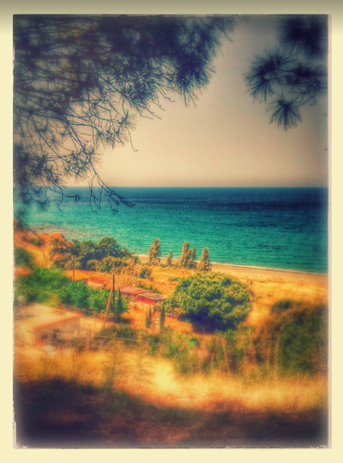
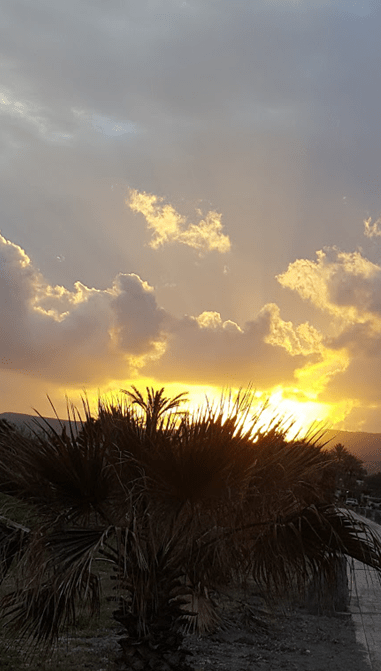
Let us study the amazing pattern on the surface of a humble leaf, and notice the sweet fragrance of the jasmine at night, or the play of the golden sunlight through the foliage or the ever-changing light on the surface of the sea.
Let us become aware of the innocence and directness of the young and the affection expressed in the eyes of those who love us.
Let us hear, as for the first time, the sound of running water – even from the tap, and the chirping of birds in the garden,
Let us be glad for the door always open for us, for a friend we can visit and for sharing a cup of tea. Let us be glad for a good book to read and for a night’s good sleep.
click here for Greek
 Open Reflections
One thought on “BEAUTY SEEN…”